The Wreck of the Valiant Is Here

The most infamous warship in history was destroyed eight years ago. Elara Voss has just found it, and someone is still alive inside.
I am excited to announce the release of my new science-fiction novel, The Wreck of the Valiant, Book One of The Iron Finch Voyages.

This full-length space opera combines a mysterious derelict warship, a powerful interstellar conspiracy, a capable female captain, found family, artificial intelligence, military action, and a slow-burn, closed-door romance.

A Warship That Should Not Exist

Elara Voss was once a promising Union Fleet engineer. After refusing an order that would have sacrificed civilians, she lost her commission and rebuilt her life as captain of the Iron Finch, a battered salvage tug held together by determination, ingenuity, and a crew that has become her family.

Now the Iron Finch is one failed salvage claim away from being repossessed.

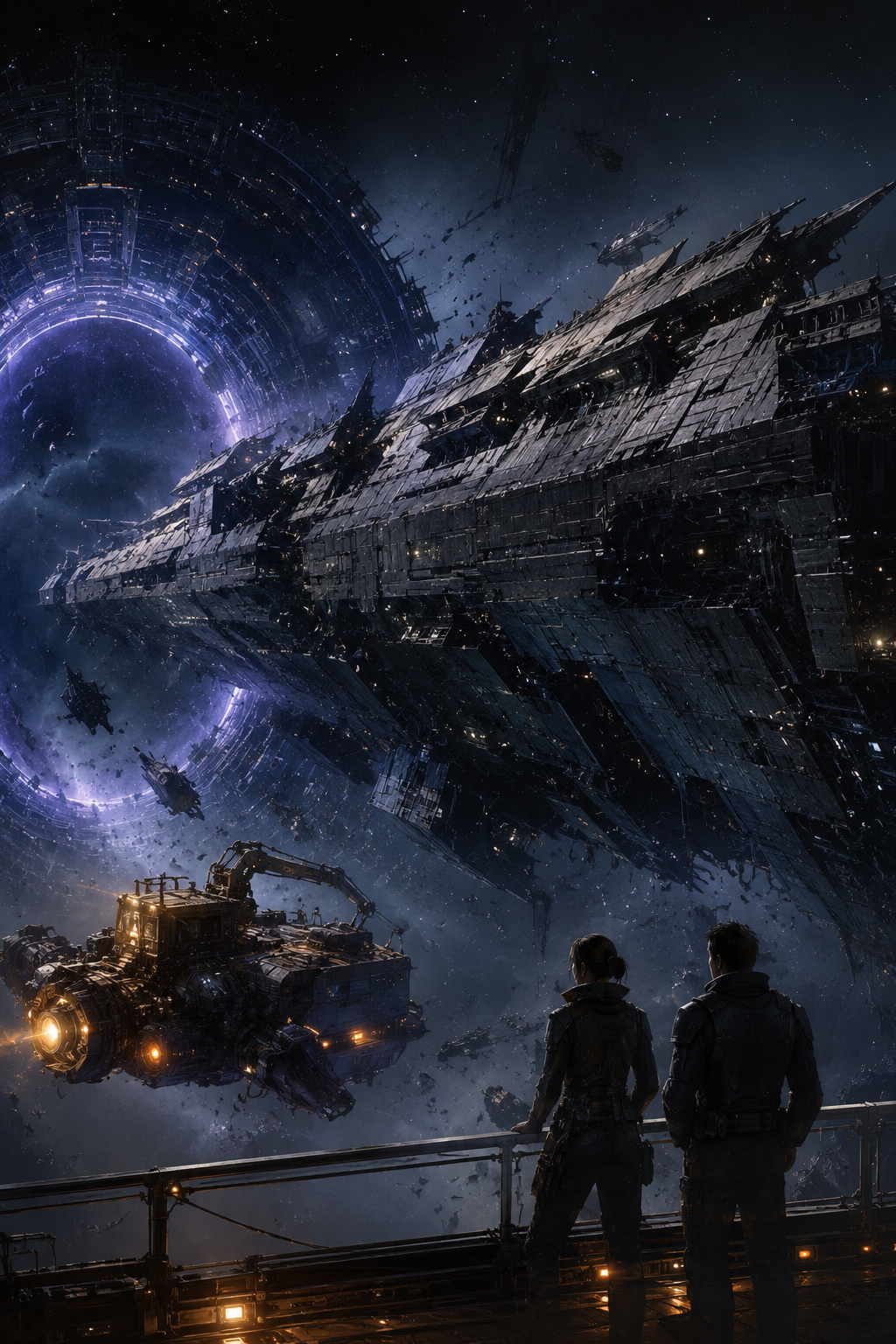
While searching the Nadir debris field for anything valuable enough to save her ship, Elara’s crew detects an object hidden in the gravitic shadow of a dormant transit gate. It is enormous, silent, and missing from every modern navigation record.

Then an ancient identification signal begins repeating a single word:

Valiant.

The Valiant was a legendary League dreadnought supposedly destroyed eight years earlier. It was blamed for the Lysander massacre, the atrocity that ignited the Meridian War and killed Elara’s older brother, Jalen.

Every history book says the ship was destroyed.

Every military record says its crew died with it.

Every memorial says its commander was a monster.

The records are wrong.

Thousands of Empty Beds

Inside the Valiant, Elara discovers a ship that is damaged but strangely intact. Its corridors remain pressurized. Personal belongings have been left behind. Internal systems begin awakening as she moves deeper into the wreck.

Then she finds the stasis decks.

Thousands of pods stand open and empty. There are no bodies, no signs of panic, and no explanation for what happened to the people who once occupied them.

A hidden passenger manifest reveals that the Valiant rescued 3,118 civilians from Lysander before it disappeared. Someone later transferred those survivors to unmarked ships and erased them from the historical record.

Only one stasis pod remains occupied.

Inside is Commander Cassian Rook, the Ghost of Nadir, the man blamed for ordering the massacre and the man Elara has hated for eight years.

Cassian awakens believing only hours have passed since a mutiny aboard his ship. He insists he never ordered the attack. He claims the Valiant rescued the survivors and was carrying them toward safety when his own officers turned against him.

Then he says the one thing Elara cannot ignore.

Her brother survived the initial attack.

Jalen was aboard the Valiant.

The War Ended, but the Lie Survived

Before Cassian can prove his story, the Gatewright Consortium arrives with orders to destroy the dreadnought, erase its records, and kill everyone aboard.

Gatewright controls the transit gates connecting humanity’s settled systems. It controls the routes ships travel, the information moving between worlds, and the records people accept as historical truth.

The Valiant contains evidence that could destroy that control.

Forced to flee aboard a dreadnought that is barely holding together, Elara and her crew must restore the ship’s damaged systems, awaken its fragmented artificial intelligence, and follow a trail of missing witnesses across the stars.

Every answer pulls them deeper into a conspiracy spanning both sides of the former war.

Someone manufactured the Lysander massacre.

Someone forged Cassian’s orders.

Someone erased thousands of survivors.

Now the architects of the first atrocity are preparing to create another.

“The Valiant isn’t just salvage, Elara. It’s evidence.”

A Romance Built on Earned Trust

At the beginning of the story, Elara sees Cassian as the living face of her grief. Cassian sees Elara as the sister of a man he tried and failed to save.

Their relationship does not begin with instant trust or easy forgiveness.

It develops through shared danger, professional respect, difficult honesty, and the experience of keeping a dying ship and its small crew alive. Elara must decide whether believing Cassian would betray her brother’s memory. Cassian must stop treating himself as expendable and learn that partnership means allowing other people to share the choices as well as the risks.

Their relationship progresses from adversaries, to reluctant allies, to equal partners.

The romance is slow-burn and closed-door, with no explicit sexual content. It remains closely connected to the central mystery and the choices Elara and Cassian must make.

What You Will Find in The Wreck of the Valiant

The Wreck of the Valiant includes:

  • A capable adult female captain and engineer

  • A colossal derelict dreadnought hiding a wartime secret

  • A loyal found-family salvage crew

  • A damaged military artificial intelligence

  • Fleet battles, boarding actions, and dangerous transit gates

  • A conspiracy controlling interstellar travel and information

  • An enemies-to-allies-to-lovers relationship

  • A slow-burn, closed-door romance

  • Dry humor, practical problem-solving, and high-stakes action

  • A complete central story with the beginning of a larger series

Welcome Aboard the Iron Finch

I wrote The Wreck of the Valiant for readers who enjoy character-driven space opera, battered ships, competent crews, artificial intelligence, military mysteries, corporate conspiracies, and romances built on trust rather than instant attraction.

The novel tells a complete story while beginning The Iron Finch Voyages, a series following Elara, Cassian, and the Iron Finch crew as they search for missing survivors, forgotten ships, unauthorized transit routes, and the secrets still buried in the wreckage of the Meridian War.

The first voyage begins with a ship that should be dead.

It begins with thousands of people erased from history.

It begins with a salvage captain discovering that the monster she has hated for eight years may be the only person who can help her uncover the truth.

Thank you for supporting my work. After reading, please consider leaving an honest review on Amazon. Reviews help independent books reach new readers, particularly readers searching for science fiction with strong characters, found family, and a meaningful romantic storyline.

The Valiant has awakened.

The truth is still aboard.

And the war is not as over as everyone believes.
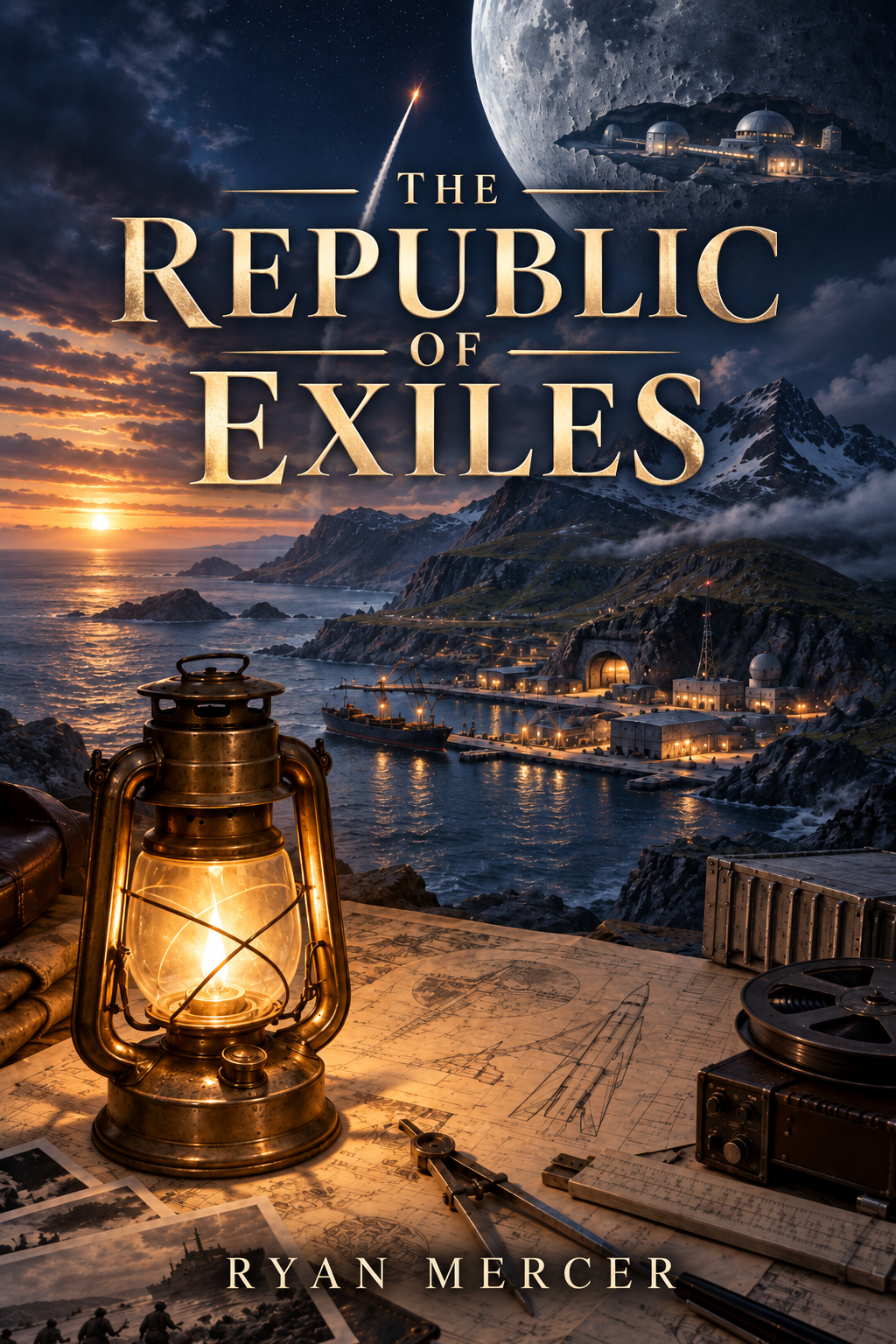
Introducing The Republic of Exiles, Book One of The Concord Series

Some people escape history. Others build what comes next.

I am excited to introduce The Republic of Exiles, the first novel in The Concord Series, a sweeping alternate-history and hard science fiction saga spanning World War II, the Cold War, the Space Race, and humanity’s first permanent steps beyond Earth.

The story begins in 1943, when American industrialist Thomas Lyle becomes convinced that the end of World War II will not bring lasting peace. Germany may be defeated, but its scientists, engineers, factories, and research programs are already becoming prizes in a new struggle between the United States and the Soviet Union.

Thomas believes that another war is coming, one armed with rockets, nuclear weapons, surveillance systems, and technologies capable of placing the entire world at risk.

His answer is Project Lantern.

A civilization built from the people history overlooks

Project Lantern is a clandestine recruitment and rescue network operating across wartime Europe. Its mission is not limited to collecting famous scientists.

Thomas Lyle and physician Miriam Rosenfeld understand that a new civilization cannot be built by a handful of celebrated geniuses. It also needs machinists, technicians, draftsmen, nurses, teachers, farmers, accountants, translators, toolmakers, production supervisors, and families.

Project Lantern begins extracting entire technical communities before they can be captured, imprisoned, prosecuted, or absorbed into the programs of the victorious powers.

Some of the recruits are refugees.

Some are resistance members.

Some worked for governments they hated because refusing would have meant imprisonment or death.

Others carry histories that are far more difficult to excuse.

Every rescue forces Project Lantern to confront the same question: Who deserves a second chance, and who has done too much harm to be welcomed into a new society?

The rise of the Concord

The refugees are transported to the remote San Telmo Archipelago, where they establish a hidden settlement under the cover of a mining and shipping development project.

What begins as a temporary refuge gradually becomes a country.

The residents call their new society the Concord, an independent civilization that claims no connection to the governments, borders, and rivalries of the world they left behind.

Its secret leadership, the Long Horizon Committee, promises that strict control is only temporary. Elections, open records, freedom of movement, and full self-government can come later, once the settlement is safe.

But temporary powers have a way of becoming permanent.

The first generation remembers war, occupation, genocide, and displacement. Many are willing to accept secrecy in exchange for survival.

The generation born inside the Concord remembers none of those things. They do not see themselves as refugees waiting for the danger to pass. They see themselves as citizens of a country that refuses to let them govern it.

Financing a hidden nation

The Concord does not possess a magical source of wealth, alien technology, or limitless resources.

It finances itself through the Meridian Development Trust, a global network of corporations, foundations, shipping companies, research institutes, and patent-holding firms.

Meridian commercializes technologies that genuinely existed, or were close to existing, during the middle of the twentieth century. These include:

  • Magnetic tape recording

  • Industrial microwave systems

  • Refrigeration and freeze-drying

  • Transistorized hearing aids

  • Numerical-control machine tools

  • Solar cells

  • Standardized shipping containers

  • Office copying systems

  • Business computers

  • Semiconductor manufacturing

  • Desalination and water-recycling systems

  • Automated mining equipment

The public versions of these inventions remain only slightly ahead of real history. Meridian earns money by introducing products at the right moment, improving manufacturing quality, and building long-term service and licensing networks.

The Concord keeps its best designs for itself.

Its true advantage is not a single revolutionary invention. It is the ability to bring scientists, engineers, machinists, physicians, and manufacturers together decades earlier than they would have worked together in the outside world.

That advantage eventually gives birth to Hesperus, the Concord’s secret space program.

A different kind of space race

The American and Soviet space programs compete for public victories.

Hesperus has a different goal.

It does not want to plant a flag, take photographs, and return home. It wants to create a permanent human settlement beyond the reach of any Earth government.

Through offshore launch platforms, hidden tracking stations, automated cargo missions, compact computers, and closed-loop environmental systems, Hesperus begins building Somnium Station near the lunar south pole.

By the time Apollo 11 approaches the Moon in July 1969, twelve people are already living beneath the lunar surface.

They watch the public landing from a concealed station that the rest of humanity does not know exists.

But reaching the Moon does not solve the Concord’s problems.

It only gives those problems somewhere new to spread.

The lie beneath Hesperus

The Concord’s greatest technological achievement rests partly on the work of Dr. Konrad Weiss, a German propulsion specialist with expertise essential to the development of Hesperus.

Weiss was originally rejected by Project Lantern because of evidence connecting him to the exploitation and deaths of forced laborers.

Thomas Lyle rescued him anyway.

He gave Weiss a false identity, concealed his history, and allowed him to become one of the hidden architects of the Concord’s space program.

Thomas tells himself that saving Weiss allowed him to save thousands of others. Without Weiss, Hesperus might never have reached the Moon.

When the truth finally emerges, the Concord must decide whether its survival justifies the crimes committed in its name.

Security Director Anton Varga believes the answer is clear. The Concord is too important to be placed at risk by elections, public trials, or citizens who do not understand the threats surrounding them.

Miriam Rosenfeld, Hana Novák, Samuel Rosenfeld, and the generation raised inside the Concord believe something different.

A refuge that cannot trust its own people is not free.

A civilization built to escape tyranny cannot survive by reproducing it.

A story about more than reaching the Moon

Although The Republic of Exiles eventually reaches the lunar surface, this is not only a space-race novel.

It is also a story about recruitment, industrial development, family, memory, secrecy, and nation-building.

The book follows people trying to construct the practical foundations of a civilization:

  • How do refugees from hostile nations learn to live together?

  • Who writes the laws?

  • Who controls the factories?

  • Can a citizen choose to leave?

  • How much technology can be sold without exposing the society that created it?

  • Can scientific knowledge be separated from the crimes of the people who produced it?

  • What happens when a government created for an emergency refuses to surrender its emergency powers?

  • Does escaping the old world make it possible to build a better one?

The Concord is neither a perfect utopia nor a simple dystopia.

It provides safety, education, medical care, housing, and opportunity to people who might otherwise have died or disappeared into the machinery of the Cold War.

It also survives through forged identities, hidden corporations, surveillance, restricted movement, and an unelected leadership convinced that it knows what is best for everyone.

The people of the Concord must decide which parts of their society are worth preserving and which parts must be dismantled before they become permanent.

The beginning of The Concord Series

The Republic of Exiles covers the creation of Project Lantern, the rise of the Meridian Development Trust, the founding of the Concord, the development of Hesperus, and the establishment of Somnium Station.

The novel culminates during the Apollo 11 landing, when the hidden residents of Somnium watch Neil Armstrong and Buzz Aldrin take humanity’s first public steps on another world.

Beyond them, another project is already beginning.

The first experimental component of Barsoom One, the Concord’s proposed Mars expedition, has reached lunar orbit.

Future books in The Concord Series will explore the growth of Somnium Station, the political relationship between Earth and the Moon, the growing risk of discovery, and the attempt to build a spacecraft capable of carrying human beings to Mars.

The Concord escaped the nations of Earth.

Now it must determine what kind of civilization it will carry into space.

Everything We Lost Is Still There

Everything We Lost Is Still There

A New Standalone Science Fiction Thriller by Ryan Mercer

Some things are gone forever.

At least, they are supposed to be.

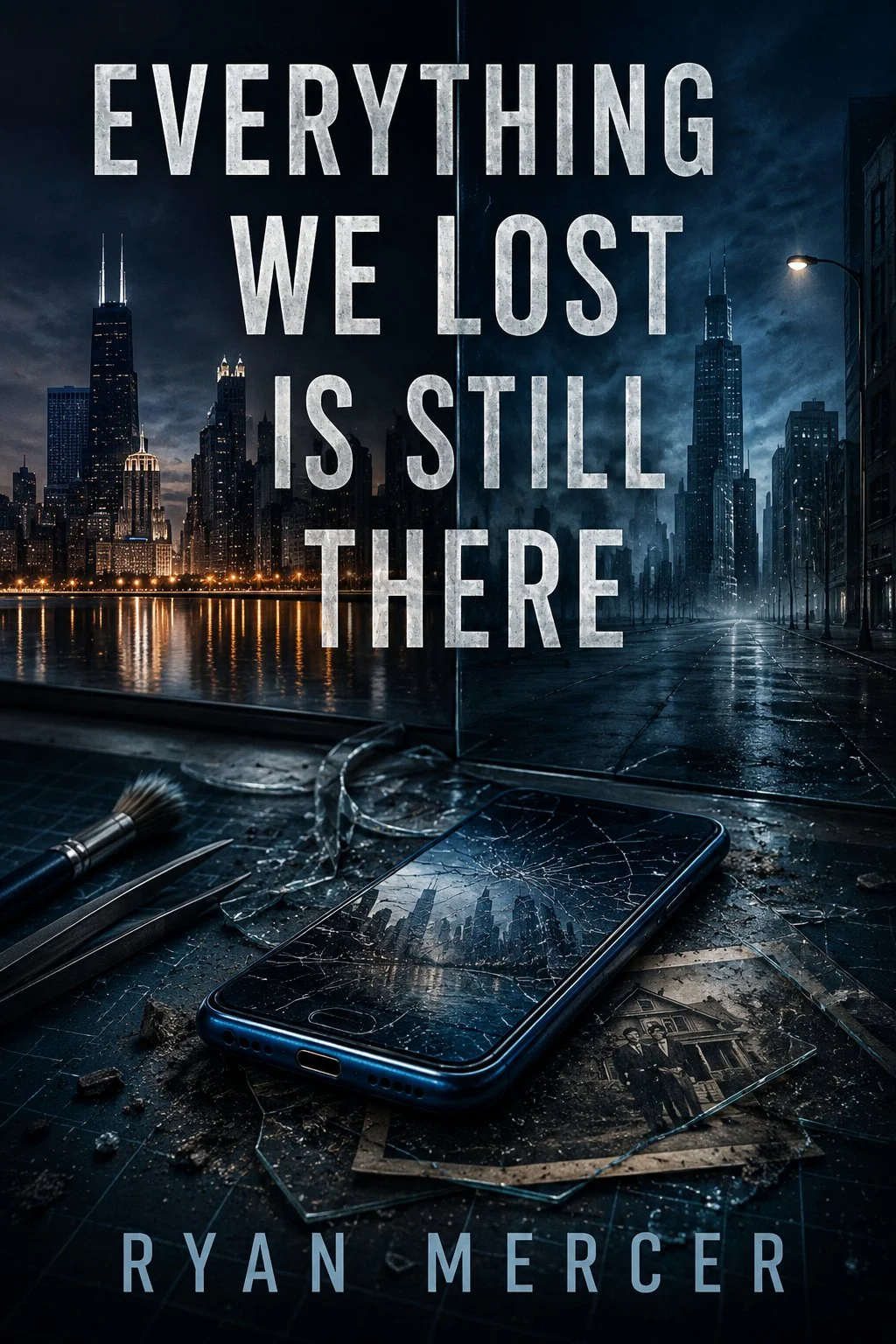
Book cover for Everything We Lost Is Still There by Ryan Mercer, featuring a cracked blue phone, the Chicago skyline, and an empty parallel version of the city.

Nora Vale spends her days restoring damaged objects at Chicago’s Halcyon Museum. She can clean soot from a photograph, stabilize a cracked painting, and preserve what remains after fire, neglect, or time has done its worst.

What she cannot restore is Theo, her husband, who died fourteen months earlier in a suspicious car crash.

While testing an experimental quantum-imaging system, Nora opens a doorway into an empty version of Chicago. The streets, buildings, museums, and homes are almost exactly the same, but no people or other sentient beings exist there.

The empty city contains something even more impossible.

Everything Nora’s world has lost, stolen, burned, deleted, or destroyed still exists there.

When Nora travels to the site of Theo’s crash, she finds his destroyed blue source phone preserved inside the wreckage. The phone may contain the evidence he died trying to protect, including information that could expose one of the country's most powerful men.

Bringing it home comes with a cost.

Every object recovered from the empty world erases the human memories connected to it. A lost wedding ring can be returned, but the proposal it represents may disappear. A destroyed work of art can be restored, but the people who loved it may forget why it mattered.

As Nora searches Theo’s phone, she begins losing pieces of him. His laugh. His face. Their private jokes. Their arguments. The complicated life they shared.

To uncover the truth about Theo’s death, Nora may have to forget the man she is trying to avenge.

About the Book

Everything We Lost Is Still There is a standalone contemporary science fiction thriller about grief, memory, parallel worlds, corporate power, and the dangerous belief that recovering something lost can make a person whole again.

The story combines an eerie alternate Chicago, a mystery surrounding a journalist’s death, and an impossible moral choice. It is written for readers who enjoy accessible speculative fiction with emotional stakes, psychological suspense, and a complete ending.

The novel is currently in development. We'll post additional details and release information here as they become available.


Beyond the Open Key: The Iron Finch Voyages Continue

Beyond the Open Key: The Iron Finch Voyages Continue

The gate was supposed to be dead. Pilgrim Seven was supposed to be lost. Both assumptions were wrong.

Beyond the Open Key, Book Two of The Iron Finch Voyages, continues the story that began in The Wreck of the Valiant.

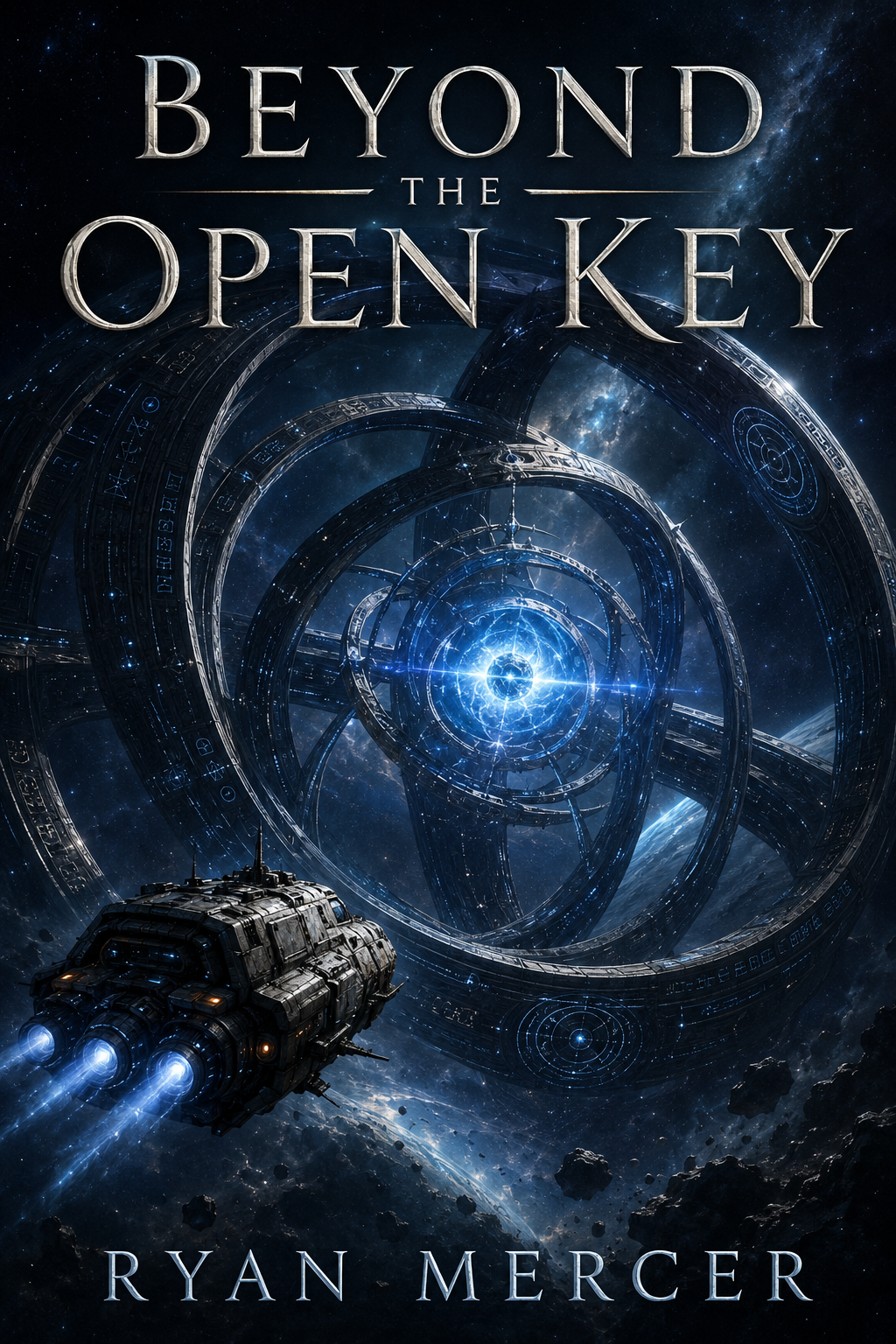
Book cover for Beyond the Open Key by Ryan Mercer, showing the small salvage ship Iron Finch approaching an enormous alien structure of nested rings surrounding a brilliant blue-white energy core.

After exposing the truth behind the Lysander massacre, Captain Elara Voss has no intention of returning to the Union Fleet. She has reclaimed her name, secured an independent recovery charter, and set a new course for the Iron Finch. Her mission is to locate the remaining Pilgrim transports and bring home the people Gatewright tried to erase.

The first trail leads to the dormant Ophiuchus gate.

When an old token left behind by Elara’s brother activates something hidden inside the supposedly dead structure, the Iron Finch crosses an aperture no human vessel was meant to find. On the other side waits a starless system, a missing refugee transport, and an alien construction vast enough to make humanity’s greatest ships look insignificant.

Pilgrim Seven is still there.

Its 631 survivors are alive, but only fourteen months have passed for them. Their damaged ship has been repaired with an unknown black-silver material, and many of the passengers have been altered by the same technology. They are protected by the Waykeeper, an ancient intelligence that believes preserving human life is more important than allowing humans to choose what happens to it.

Elara soon discovers that Gatewright knew about this place long before the Meridian War. A surviving Gatewright director has followed the Finch through the hidden gate, determined to seize the alien structure and restore centralized control over interstellar travel.

Caught between a human authority that wants to own the gates and an alien custodian that wants to protect humanity from itself, Elara must find a third path.

Beside her is Cassian Rook, no longer a disgraced commander or a man waiting for a chance to sacrifice himself. He is Elara’s tactical partner, romantic partner, and equal in the life they are trying to build. Their greatest challenge is not discovering whether they love each other. It is learning how to share danger, responsibility, and an uncertain future without either one taking away the other’s choices.

What to Expect

  • An enormous alien megastructure hidden beyond the known gate network

  • A missing transport filled with survivors who have built their own community

  • Cosmic mystery, first contact, and practical salvage engineering

  • A morally complicated alien intelligence rather than a simple invading enemy

  • Found family aboard the Iron Finch

  • An established, family-friendly, closed-door romance

  • Questions about authority, consent, survival, and who has the right to control the road between stars

Beyond the Open Key expands the universe of The Wreck of the Valiant while continuing the stories of Elara, Cassian, Mara, Niko, Tavi, Keon, Suri, and Iona.

The first book was about uncovering the truth buried in the wreckage of the past.

This voyage is about deciding who gets to shape the future.

Read the Series

Book One: The Wreck of the Valiant
Book Two: Beyond the Open Key


Introducing No Standard Build: The Unassigned, My New LitRPG Novel

Introducing No Standard Build: The Unassigned, My New LitRPG Novel

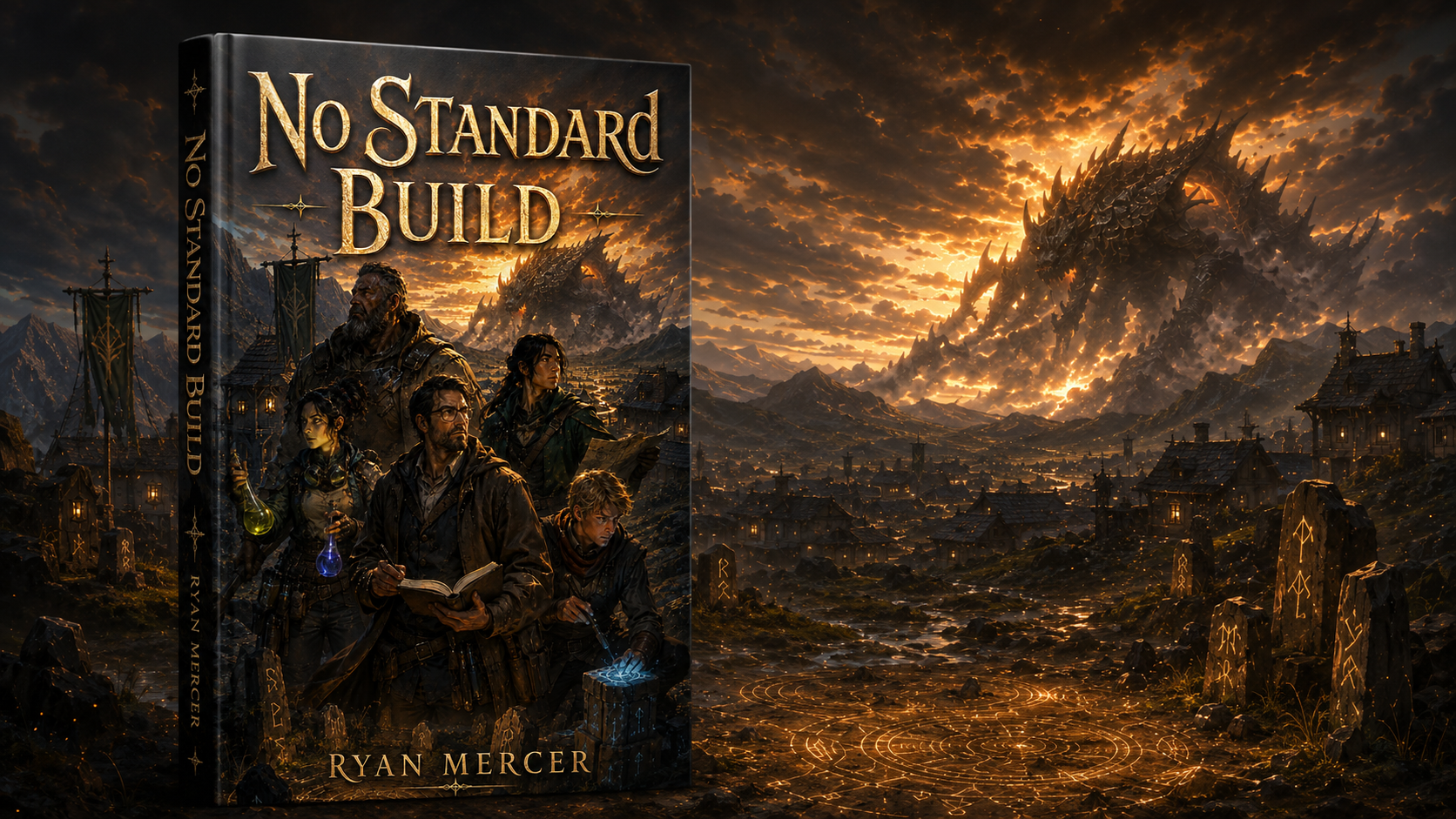
I am excited to finally share No Standard Build: The Unassigned, my new portal fantasy LitRPG and the first book in a planned series.

I have enjoyed LitRPG for years, but I wanted to approach the genre from a different direction. Instead of writing about a young warrior who becomes stronger by defeating everything in his path, I wanted a mature protagonist whose greatest abilities are observing, teaching, problem-solving, and helping other people become more capable.

That idea became Caleb Ward.

A Teacher in a World Built Around Classes

Caleb is a 41-year-old special education teacher who has spent years advocating for students whose knowledge is not always recognized by standardized assessments.

When Caleb is summoned to the Empire of Twelve Paths, he discovers a world where a single test determines almost everything about a person’s future.

Every citizen is expected to qualify for one of twelve approved magical classes. Those who fail the Concordance Assessment are labeled Unassigned. They cannot join guilds, receive enchanted equipment, serve in public positions, or even count as legal defenders of their own communities.

Caleb does not arrive as a warrior, wizard, or chosen hero. Instead, the System gives him a forbidden legacy class:

[Pathmaker]

A Pathmaker cannot gain combat attributes or become personally powerful. Caleb can only progress by helping other people turn skills they already possess into new, individualized Paths.

There is another important limitation. Caleb receives no credit when someone succeeds only because he is standing beside them and giving instructions. His class grows when the people he teaches can demonstrate real mastery without depending on him.

Meet the Unassigned

Caleb can maintain only four active Paths, and the people selected for them have spent years being told they are incapable.

Branik Tor is an injured quarry foreman who cannot perform the symmetrical stance required by the approved Bulwark class. The assessment ignores his decades of knowledge about weight, leverage, structural support, and force.

Eira Noll is an apothecary who cannot perceive the magical colors used by Imperial alchemists. She has learned to identify reactions through scent, temperature, texture, and sound, but the approved tests do not recognize her methods.

Senn Kest is an exceptional scout with a nearly perfect memory for terrain. Crowded environments and shouted battle commands overwhelm him, making it impossible to pass the standard Ranger examination.

Jory Pell cannot reproduce magical runes on parchment. When those same runes are carved into stone as three-dimensional structures, he understands them in ways trained Scribes do not.

Caleb cannot simply give them new powers. Every Path must begin with an ability they have already developed. It must carry real costs and limitations. It must work outside controlled training conditions, and it must eventually function without Caleb.

The Question Behind the Story

As a special education teacher, I spend a lot of time thinking about the difference between what a person can do and what a standardized system is able to measure.

That question became the foundation of No Standard Build.

Are we testing the skill that actually matters, or are we testing whether someone can use the one method an institution prefers?

The story is not arguing that standards are unnecessary. Reliable training, evidence, safety procedures, and honest assessments all matter. Caleb makes serious mistakes when his desire to help causes him to overprotect people or accept success too quickly.

The real conflict is about whether a standard measures genuine competence or simple conformity.

That conflict is represented by Talia Vey, an Imperial examiner who questions every claim Caleb makes. Talia is not cruel, corrupt, or opposed to the Unassigned. She has seen untested abilities fail with deadly consequences, and she refuses to certify someone simply because Caleb believes in them.

Caleb knows how to search for another path. Talia knows how to determine whether that path actually works.

They need each other, even when neither is ready to admit it.

Thirty Days to Save Rookstone

Caleb and his new party have only thirty days to prove themselves.

The failing mining settlement of Rookstone is about to lose its protective charter because the Empire refuses to count Unassigned residents among its defenders. At the same time, the Red Run is approaching.

The creatures leading the migration do more than attack. They observe standard classes, learn their formations, and adapt to repeated strategies.

To save Rookstone, Caleb’s party must become reliable without becoming predictable.

Along the way, they uncover evidence that individualized Paths were not a flaw in the magical System. They may have been what the System was originally designed to create.

What Readers Can Expect

No Standard Build: The Unassigned includes medium-crunch LitRPG mechanics, a noncombat protagonist, an adult cast, party progression, settlement defense, tactical battles, dry humor, a slow-building relationship, and characters whose abilities develop through practice rather than effortless power.

At its heart, it is a story about people who have been underestimated, mismeasured, and told that they do not fit any available path.

Sometimes the problem is not the person.

Sometimes the available paths are simply too narrow.

[BUTTON: Read No Standard Build on Amazon]