Five Questions About Mormon History That Sent Me Back to the Sources

Ask when the Latter-day Saints stopped practicing plural marriage and you’ll probably hear one year: 1890. Then there’s the wedding on the boat. A ledger kept by Church scribes records 25 plural marriages performed after the 1890 Manifesto. Eighteen took place in Mexico, six in the United States, and one aboard a boat on the Pacific Ocean. That last entry makes me wonder about the people on deck that day and what they understood the Manifesto to mean.

That’s the kind of detail that got me working on five websites about Mormon history and doctrine. Each starts with a question I wanted to spend some time with. Sometimes there’s a handwritten page you can read for yourself. Sometimes two Church presidents addressed the same subject more than a century apart and said strikingly different things. Here’s where I’d start.

Did polygamy end in 1890?

Wilford Woodruff’s Manifesto left plural families with an immediate question. What were husbands, wives, and children who had already made covenants to one another supposed to do? Some families separated. Others stayed together and had more children. Then there were the people in that ledger who entered new plural marriages. In 1904, President Joseph F. Smith issued a second Manifesto making both entering and performing a new plural marriage grounds for excommunication. Those fourteen years deserve more than a footnote.

DidPolygamyEndIn1890.com

What did John Taylor write in 1886?

Four years before Woodruff issued the Manifesto, President John Taylor wrote down a revelation dated September 27, 1886. It opens with a question about how far the new and everlasting covenant binds the Saints. Near the end comes a phrase that matters enormously to the debate over plural marriage: “the works of Abraham.” If you’ve encountered the story through Ogden Kraut or through later accounts of who received authority to continue plural marriage, try reading Taylor’s handwritten page first. What would you understand those words to require if that page were all you had?

The1886Revelation.com

What did Brigham Young teach about Adam?

In an April 1852 sermon, Brigham Young spoke about Adam arriving in Eden and called him “our Father and our God.” In October 1976, Spencer W. Kimball addressed the Adam-God theory in general conference and said, “We denounce that theory.” I’d put those two addresses side by side. Read the paragraphs around Young’s words, then read Kimball’s counsel to Church teachers. You can see both why early Saints took Young’s words seriously and why a Latter-day Saint hearing the idea today might be surprised by them.

AdamGodDoctrine.com

Was God once a man?

At the April 1844 conference in Nauvoo, Joseph Smith spoke to people mourning a man named King Follett. In answering a question about death, he also addressed God’s past and what human beings might become. Four listeners took notes. Their accounts give us a chance to read how people in the crowd heard the sermon that day. Lorenzo Snow later put the idea into two memorable lines. The Church’s essay Becoming Like God makes an observation worth pausing over: Latter-day Saints teach a great deal about becoming like Heavenly Father and comparatively little about what Heavenly Father once experienced.

WasGodOnceAMan.com

Was Jesus married?

Start with the wedding at Cana in John 2. Jesus and his disciples are invited. His mother notices that the wine has run out. Later, the man overseeing the feast calls for the bridegroom, whose name John leaves out. In 1854, Apostle Orson Hyde preached a sermon identifying Jesus himself as that bridegroom. What interests me is how Hyde got there. With the chapter open beside the sermon, you can follow his argument and decide how much weight it carries.

WasJesusMarried.com

If you only have time for one, I’d start with the question you think you already know the answer to. And if there’s a sermon, diary entry, or family letter you think I ought to read, I’d genuinely like to hear about it. A name, a date, or a page number gives me somewhere to start.
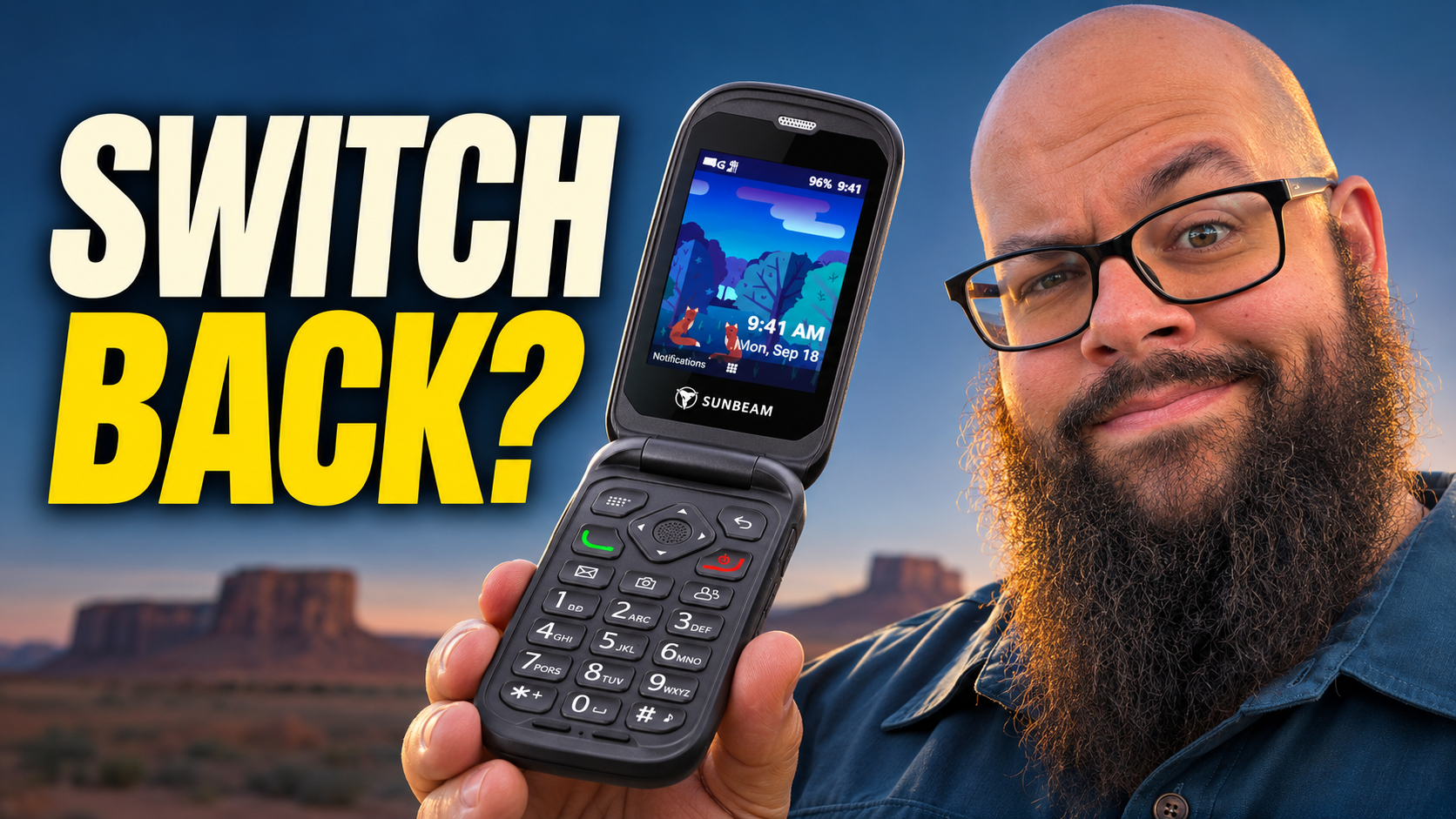

Sunbeam F1 Pro Walnut Review: Could I Switch Back to a Flip Phone?

I make YouTube videos, so I have a professional interest in people watching YouTube. I’d still like to answer a text in line at the post office without finding myself twenty minutes into a video about a watch I don’t own. The $389 Sunbeam F1 Pro Walnut makes an interesting offer. I can leave YouTube off my phone and still use that same phone to get my laptop online when I have a video of my own to upload.

Living in Monument Valley also makes me picky about what I’m willing to give up. I can leave social media at home. I’d like to keep my directions, my music, and whatever message my wife sent while I was halfway to town. Those are the things that made me take the Walnut seriously.

Watch my Sunbeam F1 Pro Walnut video review on YouTube

What I’d miss first

Before switching phones, I’d check the family group chat. The Walnut handles ordinary texts and picture messages. If my wife asks which item I’m looking at in the store, I can send a picture and get a yes or no. An existing RCS group conversation takes more work. The Walnut can’t receive those messages, so the group would need to use MMS for me to stay in the loop. If everyone already uses Signal, Sunbeam’s Dewdrop messenger can reach them there. That’s an easier conversation to have than asking six relatives to change a setting because I bought a flip phone.

The feature I’d miss next is dictation. The Walnut has it, but Sunbeam puts voice-to-text in its optional Premium subscription at $3.50 a month or $40 a year. I’d happily type “on my way” on a number pad. The first time somebody asks me to spell out “Oljato-Monument Valley,” I’m going to have stronger feelings about that subscription. At $389, I’d like dictation included.

A flip phone that can get my laptop online

The hotspot is the best argument for choosing the Walnut. Say somebody emails me a revised schedule. I can open the attachment on the phone, check what time I need to be there, and close it. If they want me to edit the schedule and send it back, I can get out my laptop and connect it to the Walnut over Wi-Fi. Having to unpack a computer is a surprisingly good way to find out how urgently I want to do something.

Waze earns its spot for a different reason. When I’m a few hours from home, I want to be able to enter an address and get directions. The Walnut has a 2.8-inch touchscreen, and Sunbeam specifically recommends using it for Waze. I like having physical keys for dialing and a touchscreen for the task where tapping makes more sense. There’s no web browser, social feed, or app store waiting when I arrive.

A headphone jack and an honest battery estimate

One of my favorite details is the 3.5 mm headphone jack. The Walnut has an offline music player, and Sunbeam’s F1 Pro spec sheet lists 32 GB of internal storage plus a microSD slot that accepts another 32 GB. I could load a few favorite albums, plug in a pair of wired headphones, and listen even where cell service drops out. As a bonus, the headphones would be one less thing I forgot to charge.

I also appreciate how Sunbeam describes its 2,200 mAh battery. The company estimates a little over a day in an area with poor signal and more than two days with intermittent use. Out here, that first number tells me more than a best-case figure ever could. A USB-C charger and a desk dock come in the box, so the phone can have a regular parking spot when I get home. Sunbeam’s F1 Pro hardware spec sheet (PDF)

Is the Walnut worth $389?

If all I wanted were calls and texts, I’d have a hard time spending $389 on the Walnut. The case for it is more specific. I want directions on the road, a way to reach my family, and the option to get a real computer online. I’d also like closing my phone to be the end of whatever I picked it up to do. The Walnut comes pretty close to that combination.

My decision would come down to the people I text every day. I can move my music onto a memory card in an afternoon. Getting the whole family to agree on a messaging app might be the more ambitious project. See the F1 Pro Walnut at Sunbeam Wireless

Knafs Lander 2 Review: Would I Retire My Old Pocketknife for This?

I’ve carried the same pocketknife for several years. Nothing dramatic happened to it. I just wanted to try something new, and Knafs is based in Clearfield, about six hours from me here in Monument Valley. By Utah standards, that practically makes us neighbors. So I checked out the Lander 2 in Moondust Micarta. The olive handle is what I’d have picked off a shelf. The fact that I can replace it with a trout or a cat in a spacesuit requires a little explanation. Clutch Lock

Watch my Knafs Lander 2 video review on YouTube.

The part that would earn a spot in my pocket

For a knife that spends most of its day folded up, the two numbers I care about are 4.25 inches and 2.75 ounces. That’s the closed length and weight of the Moondust version. Open it and you get a 3.25-inch S35VN stainless steel blade with a curved cutting edge. The olive canvas Micarta has a visible weave, and the gray stonewashed blade looks right alongside it. Of the three looks in this review, this is the one I’d want to live with for years. Clutch Lock

Two details matter more to me than the finish. The Clutch Lock works from either side, and the pocket clip can move to the other side too. Nick LeFort spent a month carrying the G10 version for GearJunkie. He could get all four fingers around the handle and found the action particularly smooth, although he thought people with smaller hands might find it a little large. That’s a useful distinction: a knife can be light in your pocket and still feel substantial in your hand. Clutch Lock

Lore Lab’s review put a finer point on the blade shape. Their reviewer used a G10 Lander 2 for cardboard and camp cooking. The curve toward the tip gave them plenty of edge for slicing on a board, but they had to raise the handle farther to get the tip down to the surface. I’d take that trade for a knife that might open a shipping box one day and slice an apple the next. LORE LAB

Brook Trout or Kitty Cosmo Crew?

“Scales” are the two panels on the outside of the handle. Knafs’ Fast Swap system lets you change them without taking the whole knife apart. As someone who keeps a pocketknife for years, I like that for a fairly boring reason: if I wear out a handle or get tired of looking at it, I can keep the blade and lock I already know. knafs.com

The Brook Trout G10 scales are the cleverer design. There’s no picture of a fish posed on the side. The whole handle takes on the markings of its flank: an olive back, pale spots and a wash of orange along the bottom. It would look right at home in a tackle box. Out here in the desert, it may also be my best shot at coming home with a trout.

The Kitty Cosmo Crew scales take the opposite approach. There’s a cat named Sfank floating through space after a pocketknife just beyond his reach. I appreciate that somebody at Knafs had to approve both that artwork and the name “Sfank.” These are the ones I’d put on first. Kitty Cosmo Crew G10

Both sets are $19.99, and both designs are UV printed on G10. Knafs says the artwork can chip with normal use. If wear on the illustration would bother you, I’d stick with the Micarta. It already looks good, and it comes with the knife. Brook Trout G10

Would I switch?

At $144.99 for the Moondust model, I’d buy the Lander 2 on the strength of the stock knife. If all you need is something to open the mail, I’d keep what you have. What makes this one worth considering is that Knafs sells replacement hardware, right down to the screws, springs and pocket clip. For someone shopping for the next knife to carry for several years, knowing a lost screw doesn’t mean starting over is worth more than an extra set of scales. Clutch Lock

So yes, I’d give the Lander 2 my pocket for a while. My old knife has earned a spot in the drawer. And if it ever comes back into rotation, it’ll be because I missed it. It’s going to have a hard time competing on space cats.

Sheffield World Time Solar Review | Better After Dark

The first thing I like about the Sheffield World Time Solar is that the names around the bezel glow. On plenty of watches, the hands and hour markers light up and the rest of the dial disappears. On this one, you can still pick out Denver, Chicago, and New York in green around the edge. Sheffield based the design on a World Time watch it made in the 1960s. For $174, that’s a lot more personality than I expect from a watch I can leave on a shelf for weeks and pick up ready to go. Sheffield


What the bezel is good for

I live in Monument Valley, Utah, which Sheffield somehow overlooked when it was engraving the bezel. Fortunately, Denver will do. Say it’s ten in the morning here and I want to call somebody in New York. I turn the bezel until Denver lines up with ten. New York now sits at twelve, and Los Angeles sits at nine. One twist tells me who’s at lunch and who’s still working on their coffee.

You do have to line it up again the next time you check, and keep track of daylight saving differences yourself. For somebody who wants home time visible all day while traveling, I’d go with a GMT. For the occasional call across time zones, I like the Sheffield. Most of my other rotating bezels have spent their careers timing frozen pizzas.

How the Sheffield handles light

The broad arrow hour hand is easy to pick out against the black dial, even with all that lettering around it. The interesting question is how long the glow lasts. John Stark, an owner who reviewed the watch on Sheffield’s site, liked the initial brightness but wished it lasted longer. I’d buy this for the way it looks when the lights go down. If you need to read it at four in the morning, that owner’s experience is worth weighing. Sheffield

I usually lean toward automatics, but the Miyota 2070 solar quartz movement makes sense for the way I rotate watches. A slim solar cell around the edge of the dial collects both sunlight and indoor light. Miyota rates a full charge for four months. When the seconds hand starts jumping two seconds at a time, that’s the cue to give it more light. Going outside is my kind of charging cable. ™ÛâüÉ

Would I wear it?

Yes, though I’d pay attention to the fit. The steel case measures 40 mm across, 48 mm from lug to lug, and 13 mm thick. That last number matters if you like a watch that slips under a snug cuff. You also get anti-reflective sapphire, a screw-down crown, and 200 meters of rated water resistance. The drilled 20 mm lugs are a detail I appreciate. One owner who usually wears theirs on silicone tried gray leather, and that’s the combination I’d pick for this dark dial and brushed steel. Sheffield

At $174, the solar movement is what makes the Sheffield easy to own. The glowing bezel is what would make me choose it out of a watch box full of perfectly sensible alternatives. Also, if Sheffield ever does a Monument Valley edition, I know a guy.

See the Sheffield World Time Solar and read the owner reviews.

Nubeo Elysium Review: This NASA Watch Has a Hidden Message

I wanted the white one. It looked like it belonged on the sleeve of a spacesuit. But the white Nubeo Elysium was sold out when I looked, which left me comparing the black and blue versions and asking a perfectly reasonable grown-man question. Which one feels more like NASA?

Blue Galaxy won me over. The white NASA lettering sits low on a wide-open blue dial, just below a little round date window at six o’clock. Then there’s the bright red crown sticking out of the brushed steel case. It looks enough like a button that some part of me wants a little plastic cover over it and a second person to authorize turning it.

Give it a little ultraviolet light

In daylight, there’s enough empty space on that dial to make you wonder why Nubeo left it all there. Shine a UV flashlight on it and up pops “Failure is not an option.” That’s a pretty stern briefing for a guy checking whether he has time to microwave a burrito. Nubeo Watches

There’s a fun bit of space history tucked into those five words. The screenwriters of Apollo 13 came up with the line after interviewing people who worked the mission. Ed Harris delivered it on screen as flight director Gene Kranz, and the real Kranz later used it as the title of his autobiography. So if you read the dial and immediately hear it in Ed Harris’s voice, you’ve got the right guy. nasa.gov

Turn it over and watch the rotor

My favorite reason to pick up an automatic watch is that there’s something to look at even when I already know what time it is. Inside the Elysium is a Japanese Miyota automatic movement. Give the case a slow tilt and you can see the weighted rotor swing through the clear back. That motion winds the mainspring, which stores the energy that keeps the hands moving after I sit back down. Finally, all that talking with my hands is funding the space program. Nubeo Watches

Nubeo drew gauges and switches across the rotor and put the same Failure is not an option inscription along its edge. I like that detail even more than the glow. On the front, you get the clean NASA lettering. On the back, you get a tiny control panel that actually moves.

Would I still pick blue?

At $300, the practical question for me is size. The steel case measures 45 mm across, 48 mm lug to lug, and 13.5 mm thick. If you’re considering one, that 48 mm measurement is the one I’d compare with a watch you already wear. You also get a blue rubber strap, an anti-reflective mineral crystal, and 5 ATM water resistance. Nubeo lists 150 pieces in this color. Nubeo Watches

I’d still happily wear the white one. But if all three were sitting in front of me today, I’d reach for Blue Galaxy. That red crown against the blue is what I’d notice every time I looked down. The hidden message is what would have me handing the watch and a UV flashlight to somebody else and saying, “Here, you’ve got to see this.”

See the Nubeo Elysium Automatic NASA Limited Edition in Blue Galaxy

Why the a.b.art Freiburg 265 Has 31 Holes in Its Dial


I usually go for automatic watches. The a.b.art Freiburg 265 got my attention for a much smaller reason. There’s a single red dot on its black dial, and I wanted to know what it did. Turns out, it’s the date. Finally, a red dot on my wrist that I can leave alone without feeling like I owe somebody an email.

A whole month, one dot at a time

Look closely and you’ll see a ring of 31 tiny openings, each paired with a number. If the red dot is beside 10, it’s the 10th. At midnight, it moves one spot clockwise to 11. What I like about that arrangement is that it gives the month a shape. Even before I read the number, the position of the dot gives me a rough idea of how much month I have left.

There is one trade-off. A conventional date window gives your eye the same place to land every morning. On the Freiburg, you find the red dot and then read the little number beside it. If I’m standing at the front office trying to date a form, a big numeral wins. As a design I’d enjoy looking at every day, though? I’d take the dot.

The number I like almost as much is 6 mm

The black stainless-steel case is 41 mm across and just 6 mm thick. That gives those 31 dates room to spread out while keeping the watch slim enough for a shirt cuff. The flat black leather strap carries that slim profile through, and the white hands stand out clearly against the dial.

Under the sapphire crystal is a battery-powered Ronda 715 quartz movement with Swiss parts. I can leave it on the dresser for a few days, pick it up on a school morning, and head out the door without winding it or resetting the time. The practical limit is the 3 ATM water-resistance rating. I’d wear it to work or dinner and leave it on the dresser for a swim.

The Freiburg 265 makes sense to me because the part you’d show a friend is also the part you’d use. Ask me about most of my watches and you might get a longer answer than you wanted. With this one, I can point to the dial and say, “See that little red dot?”

See the a.b.art Freiburg 265 on the manufacturer’s website · More watch reviews on Ryan’s Wrist Check

Bertucci DX3 Edge Sahara Review: My Favorite Detail Is at Four O’Clock

If a watch crown has ever poked you in the back of the hand, take a look at the Bertucci DX3 Edge Sahara. The little knob you use to set the time sits at four o’clock, a little farther from where your wrist bends. It’s my favorite detail on this $125 field watch, and you don’t need to climb a mountain to appreciate it. Leaning on a desk will do.

I teach special education, and one of the better arguments for wearing my smartwatch is that I use timers throughout the school day. But sometimes I just want to glance down, see how much of a 20-minute reading session is left, and get back to what I’m doing. That’s where an analog watch earns its spot on my wrist.

The Sahara is mostly about the strap

Bertucci calls this version the Sahara, which, given that I live in the Utah desert, means I can probably count it as camouflage.

What I like about the color scheme is how well the pieces work together. The tan numerals pick up the color of the woven nylon strap, while the black dashes down the middle of the strap match the matte black case. The light-colored hands are easy to pick out against the charcoal dial. There’s also a smaller 24-hour scale tucked inside the main numerals, if your day occasionally requires translating 1400 into “I have a meeting in five minutes.”

The strap has a practical detail of its own: you can fold the extra length back through the keepers. I appreciate that more than another inch of nylon sticking out from the side of my wrist.

What does $125 get you?

The DX3 Edge has a 40 mm fiber-reinforced polycarbonate case, a Japanese quartz movement, and a battery Bertucci rates for about three years. I usually gravitate toward automatic watches, but quartz makes sense for someone who rotates through a collection. Leave this one on the dresser for a week, and you can pick it up Monday morning without having to set the time.

Bertucci also rates it for 100 meters of water resistance, and the luminous hands and markers charge from light. The specification that gives me pause is the mineral crystal. I don’t mind a nylon strap looking worn. A scratch right across the spot where I’m trying to read the minute hand would bother me considerably more. If sapphire is on your must-have list, I’d keep looking.

Would I put the DX3 Edge Sahara on a $125 shortlist? Yes, especially for someone who wants a light watch and likes this strap enough to leave it on. The strap, the dial, and that little four o’clock crown are what make this particular Bertucci worth a look. And if the most demanding expedition on your calendar is getting through the school day, I think that counts.

View the Bertucci DX3 Edge Sahara, model 11162, on Bertucci’s website.

VARIO 1945 D12 Bronze Review: A Field Watch I’d Let Age

If you handed me a polishing cloth with the VARIO 1945 D12 Bronze, I’d probably misplace it on purpose. I’m wearing the Fumé Grey version on the army green strap, and what I’d really like to see is this same watch five years from now. I think that green canvas will look even better once the bronze loses some of its shine.

There’s a detail that makes me especially curious: the case is bronze, but the hands are raw brass. The hands can slowly develop their own patina, too. If I take a picture of this watch today and another one a few years from now, the first thing I’m going to compare is the minute hand against that grey dial.

Take a look at six o’clock

Where you’d normally find a big numeral six, there’s a little dial with a seconds hand making its own lap. I like that arrangement on a field watch. When I glance down to see how many minutes are left before the school bell, the two big hands tell me what I need. When I have time to look closer, there’s something worth watching.

That little seconds dial and the railroad-style minute track around the edge are both nods to the “Dirty Dozen” watches made for the British military during World War II. VARIO’s design notes are worth a look if you enjoy that history. My favorite departure from the originals is also the most obvious one: the warm bronze rim against the smoky grey face. The army green strap reminds me of an old canvas field bag. I’d keep it on this one.

How big is 37 mm, really?

The D12 is 37 mm across, 10.5 mm thick, and 45 mm from lug tip to lug tip. If you’re considering one, that last number is the one I’d check. Take a watch you already like wearing and measure from the tip of its top lug to the tip of its bottom lug. Comparing that measurement with 45 mm will tell you more about the fit than a close-up photo ever could.

VARIO tucked the screw-down crown down at four o’clock, a little farther from the back of your hand when you bend your wrist. You also get a sapphire crystal with an anti-reflective coating on the inside and a 100-meter water-resistance rating. Those are practical choices for a watch that takes its styling cues from 1945.

What happens if you take it off on Friday?

Inside is a Miyota 82S5 automatic movement. It winds as you wear it, you can wind it by hand, and the seconds hand stops when you pull the crown out to set the time. Miyota rates the power reserve at about 42 hours. In practical terms, if you take it off Friday evening and leave it on the dresser, you’ll probably be setting it again Monday morning. Personally, I enjoy lining up that little seconds hand. Your Monday morning may be busier than mine.

Would I choose the bronze? At VARIO’s listed price of $428 USD, I’d choose this version if you like two things: a compact watch and a case that shows its age. If you want the watch to look much the same five years from now, I’d give the steel D12 a look. For me, the whole appeal of this one is getting to find out what those five years look like.

Would you keep the bronze polished or let it age? Let me know in the comments, and check out Ryan’s Wrist Check on YouTube for more of my watch reviews.