Everything We Lost Is Still There

Everything We Lost Is Still There

A New Standalone Science Fiction Thriller by Ryan Mercer

Some things are gone forever.

At least, they are supposed to be.

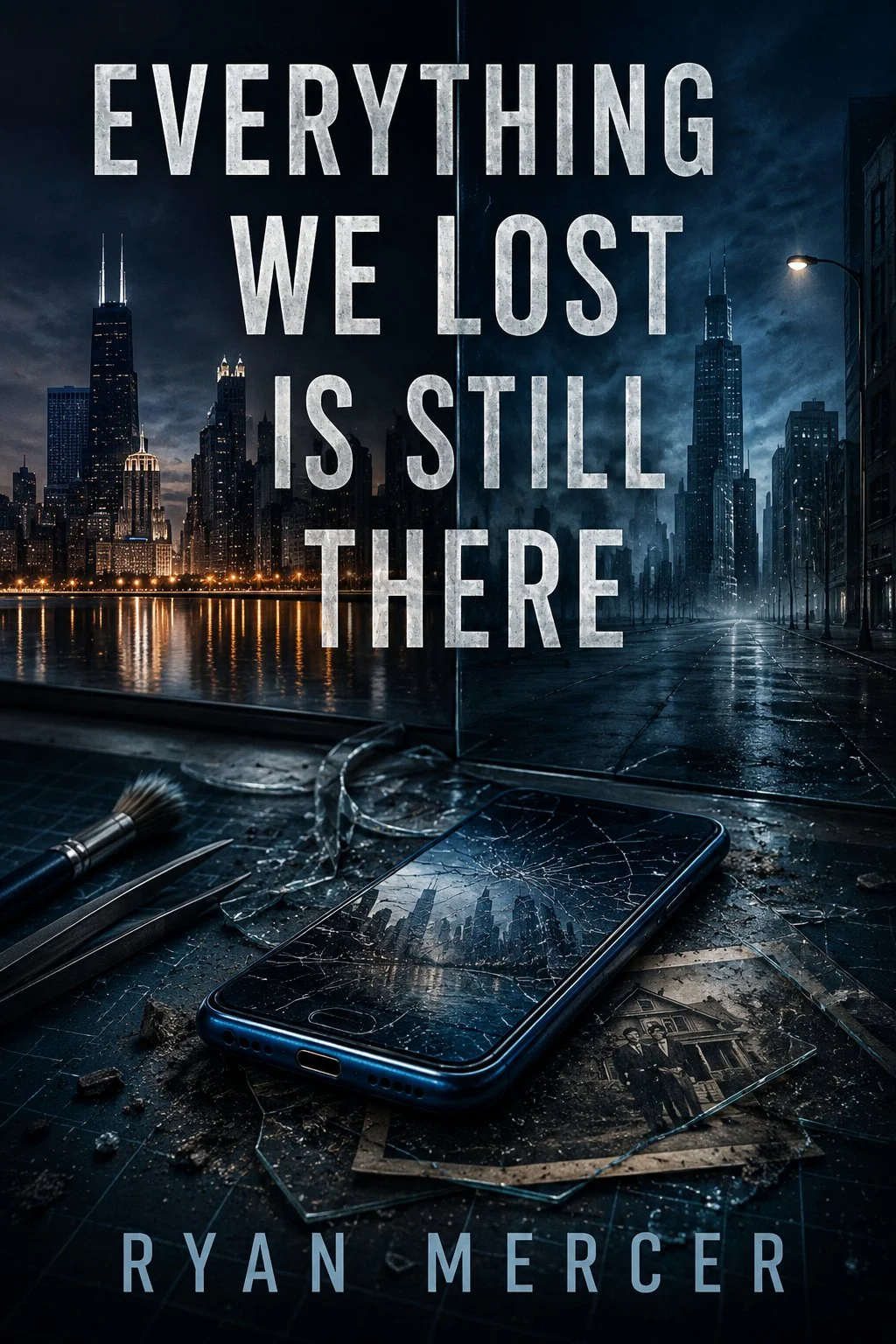
Book cover for Everything We Lost Is Still There by Ryan Mercer, featuring a cracked blue phone, the Chicago skyline, and an empty parallel version of the city.

Nora Vale spends her days restoring damaged objects at Chicago’s Halcyon Museum. She can clean soot from a photograph, stabilize a cracked painting, and preserve what remains after fire, neglect, or time has done its worst.

What she cannot restore is Theo, her husband, who died fourteen months earlier in a suspicious car crash.

While testing an experimental quantum-imaging system, Nora opens a doorway into an empty version of Chicago. The streets, buildings, museums, and homes are almost exactly the same, but no people or other sentient beings exist there.

The empty city contains something even more impossible.

Everything Nora’s world has lost, stolen, burned, deleted, or destroyed still exists there.

When Nora travels to the site of Theo’s crash, she finds his destroyed blue source phone preserved inside the wreckage. The phone may contain the evidence he died trying to protect, including information that could expose one of the country's most powerful men.

Bringing it home comes with a cost.

Every object recovered from the empty world erases the human memories connected to it. A lost wedding ring can be returned, but the proposal it represents may disappear. A destroyed work of art can be restored, but the people who loved it may forget why it mattered.

As Nora searches Theo’s phone, she begins losing pieces of him. His laugh. His face. Their private jokes. Their arguments. The complicated life they shared.

To uncover the truth about Theo’s death, Nora may have to forget the man she is trying to avenge.

About the Book

Everything We Lost Is Still There is a standalone contemporary science fiction thriller about grief, memory, parallel worlds, corporate power, and the dangerous belief that recovering something lost can make a person whole again.

The story combines an eerie alternate Chicago, a mystery surrounding a journalist’s death, and an impossible moral choice. It is written for readers who enjoy accessible speculative fiction with emotional stakes, psychological suspense, and a complete ending.

The novel is currently in development. We'll post additional details and release information here as they become available.


Beyond the Open Key: The Iron Finch Voyages Continue

Beyond the Open Key: The Iron Finch Voyages Continue

The gate was supposed to be dead. Pilgrim Seven was supposed to be lost. Both assumptions were wrong.

Beyond the Open Key, Book Two of The Iron Finch Voyages, continues the story that began in The Wreck of the Valiant.

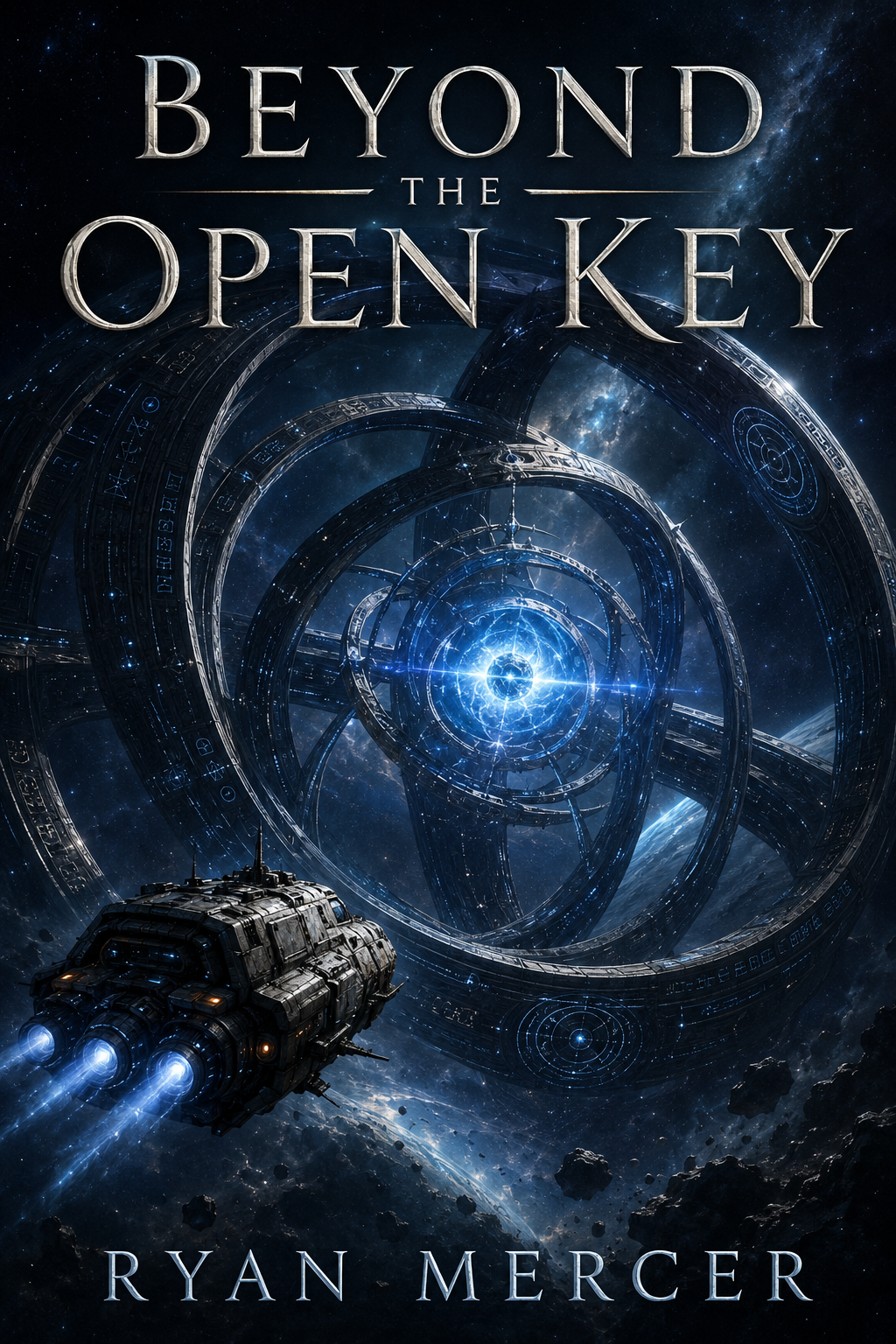
Book cover for Beyond the Open Key by Ryan Mercer, showing the small salvage ship Iron Finch approaching an enormous alien structure of nested rings surrounding a brilliant blue-white energy core.

After exposing the truth behind the Lysander massacre, Captain Elara Voss has no intention of returning to the Union Fleet. She has reclaimed her name, secured an independent recovery charter, and set a new course for the Iron Finch. Her mission is to locate the remaining Pilgrim transports and bring home the people Gatewright tried to erase.

The first trail leads to the dormant Ophiuchus gate.

When an old token left behind by Elara’s brother activates something hidden inside the supposedly dead structure, the Iron Finch crosses an aperture no human vessel was meant to find. On the other side waits a starless system, a missing refugee transport, and an alien construction vast enough to make humanity’s greatest ships look insignificant.

Pilgrim Seven is still there.

Its 631 survivors are alive, but only fourteen months have passed for them. Their damaged ship has been repaired with an unknown black-silver material, and many of the passengers have been altered by the same technology. They are protected by the Waykeeper, an ancient intelligence that believes preserving human life is more important than allowing humans to choose what happens to it.

Elara soon discovers that Gatewright knew about this place long before the Meridian War. A surviving Gatewright director has followed the Finch through the hidden gate, determined to seize the alien structure and restore centralized control over interstellar travel.

Caught between a human authority that wants to own the gates and an alien custodian that wants to protect humanity from itself, Elara must find a third path.

Beside her is Cassian Rook, no longer a disgraced commander or a man waiting for a chance to sacrifice himself. He is Elara’s tactical partner, romantic partner, and equal in the life they are trying to build. Their greatest challenge is not discovering whether they love each other. It is learning how to share danger, responsibility, and an uncertain future without either one taking away the other’s choices.

What to Expect

  • An enormous alien megastructure hidden beyond the known gate network

  • A missing transport filled with survivors who have built their own community

  • Cosmic mystery, first contact, and practical salvage engineering

  • A morally complicated alien intelligence rather than a simple invading enemy

  • Found family aboard the Iron Finch

  • An established, family-friendly, closed-door romance

  • Questions about authority, consent, survival, and who has the right to control the road between stars

Beyond the Open Key expands the universe of The Wreck of the Valiant while continuing the stories of Elara, Cassian, Mara, Niko, Tavi, Keon, Suri, and Iona.

The first book was about uncovering the truth buried in the wreckage of the past.

This voyage is about deciding who gets to shape the future.

Read the Series

Book One: The Wreck of the Valiant
Book Two: Beyond the Open Key


Introducing No Standard Build: The Unassigned, My New LitRPG Novel

Introducing No Standard Build: The Unassigned, My New LitRPG Novel

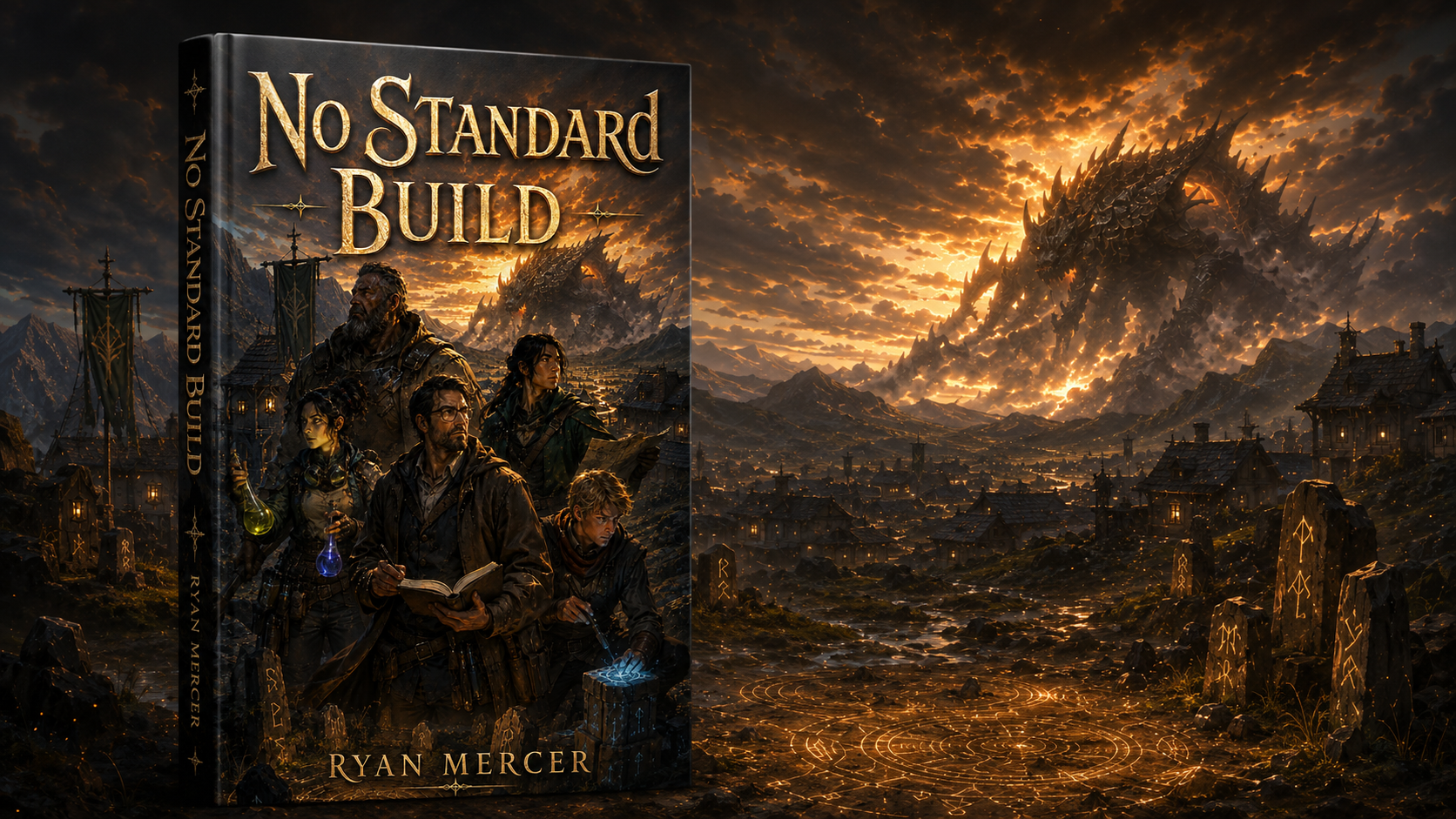
I am excited to finally share No Standard Build: The Unassigned, my new portal fantasy LitRPG and the first book in a planned series.

I have enjoyed LitRPG for years, but I wanted to approach the genre from a different direction. Instead of writing about a young warrior who becomes stronger by defeating everything in his path, I wanted a mature protagonist whose greatest abilities are observing, teaching, problem-solving, and helping other people become more capable.

That idea became Caleb Ward.

A Teacher in a World Built Around Classes

Caleb is a 41-year-old special education teacher who has spent years advocating for students whose knowledge is not always recognized by standardized assessments.

When Caleb is summoned to the Empire of Twelve Paths, he discovers a world where a single test determines almost everything about a person’s future.

Every citizen is expected to qualify for one of twelve approved magical classes. Those who fail the Concordance Assessment are labeled Unassigned. They cannot join guilds, receive enchanted equipment, serve in public positions, or even count as legal defenders of their own communities.

Caleb does not arrive as a warrior, wizard, or chosen hero. Instead, the System gives him a forbidden legacy class:

[Pathmaker]

A Pathmaker cannot gain combat attributes or become personally powerful. Caleb can only progress by helping other people turn skills they already possess into new, individualized Paths.

There is another important limitation. Caleb receives no credit when someone succeeds only because he is standing beside them and giving instructions. His class grows when the people he teaches can demonstrate real mastery without depending on him.

Meet the Unassigned

Caleb can maintain only four active Paths, and the people selected for them have spent years being told they are incapable.

Branik Tor is an injured quarry foreman who cannot perform the symmetrical stance required by the approved Bulwark class. The assessment ignores his decades of knowledge about weight, leverage, structural support, and force.

Eira Noll is an apothecary who cannot perceive the magical colors used by Imperial alchemists. She has learned to identify reactions through scent, temperature, texture, and sound, but the approved tests do not recognize her methods.

Senn Kest is an exceptional scout with a nearly perfect memory for terrain. Crowded environments and shouted battle commands overwhelm him, making it impossible to pass the standard Ranger examination.

Jory Pell cannot reproduce magical runes on parchment. When those same runes are carved into stone as three-dimensional structures, he understands them in ways trained Scribes do not.

Caleb cannot simply give them new powers. Every Path must begin with an ability they have already developed. It must carry real costs and limitations. It must work outside controlled training conditions, and it must eventually function without Caleb.

The Question Behind the Story

As a special education teacher, I spend a lot of time thinking about the difference between what a person can do and what a standardized system is able to measure.

That question became the foundation of No Standard Build.

Are we testing the skill that actually matters, or are we testing whether someone can use the one method an institution prefers?

The story is not arguing that standards are unnecessary. Reliable training, evidence, safety procedures, and honest assessments all matter. Caleb makes serious mistakes when his desire to help causes him to overprotect people or accept success too quickly.

The real conflict is about whether a standard measures genuine competence or simple conformity.

That conflict is represented by Talia Vey, an Imperial examiner who questions every claim Caleb makes. Talia is not cruel, corrupt, or opposed to the Unassigned. She has seen untested abilities fail with deadly consequences, and she refuses to certify someone simply because Caleb believes in them.

Caleb knows how to search for another path. Talia knows how to determine whether that path actually works.

They need each other, even when neither is ready to admit it.

Thirty Days to Save Rookstone

Caleb and his new party have only thirty days to prove themselves.

The failing mining settlement of Rookstone is about to lose its protective charter because the Empire refuses to count Unassigned residents among its defenders. At the same time, the Red Run is approaching.

The creatures leading the migration do more than attack. They observe standard classes, learn their formations, and adapt to repeated strategies.

To save Rookstone, Caleb’s party must become reliable without becoming predictable.

Along the way, they uncover evidence that individualized Paths were not a flaw in the magical System. They may have been what the System was originally designed to create.

What Readers Can Expect

No Standard Build: The Unassigned includes medium-crunch LitRPG mechanics, a noncombat protagonist, an adult cast, party progression, settlement defense, tactical battles, dry humor, a slow-building relationship, and characters whose abilities develop through practice rather than effortless power.

At its heart, it is a story about people who have been underestimated, mismeasured, and told that they do not fit any available path.

Sometimes the problem is not the person.

Sometimes the available paths are simply too narrow.

[BUTTON: Read No Standard Build on Amazon]
New Release: The Fifth Chair

What happens when love becomes something you can count, divide, rotate, and record?

The Fifth Chair is a Cedar Mesa Polygamy Romance about Elias Ward, a man who has mistaken fairness for tenderness. On his isolated high-desert homestead, Elias manages his plural marriage with rigid precision. Every chore, every meal, every duty, and every private obligation is written into a scuffed leather ledger so no one can accuse him of favoritism.

To Elias, the system is fair.

To the women living inside it, the system is slowly turning the house cold.

ront cover of The Fifth Chair by Ryan Mercer, showing a dark cabin interior with a table, lantern, fireplace, snowy window, and multiple wooden chairs.

The Fifth Chair by Ryan Mercer.

A story about fairness, silence, and the weight of being managed

Hannah, Elias’s first wife, has become the pillar of the household. She is steady, efficient, stoic, and exhausted. She knows the rhythms of the kitchen, the cellar, the winter stores, and the family ledger so well that no one seems to notice how much of herself has been buried beneath the work.

Leah, the second wife, moves through the Ward home like a shadow, carrying the scent of wool, lanolin, and long nights of labor. She has learned how to be quiet, how to take up less space, and how to survive inside a marriage where even intimacy has a place in the rotation.

And Elias believes he is doing the right thing.

He provides. He protects. He records. He balances.

But a ledger can only measure what is owed. It cannot measure loneliness. It cannot measure hunger for kindness. It cannot measure the grief of a woman who has been treated fairly and still feels unseen.

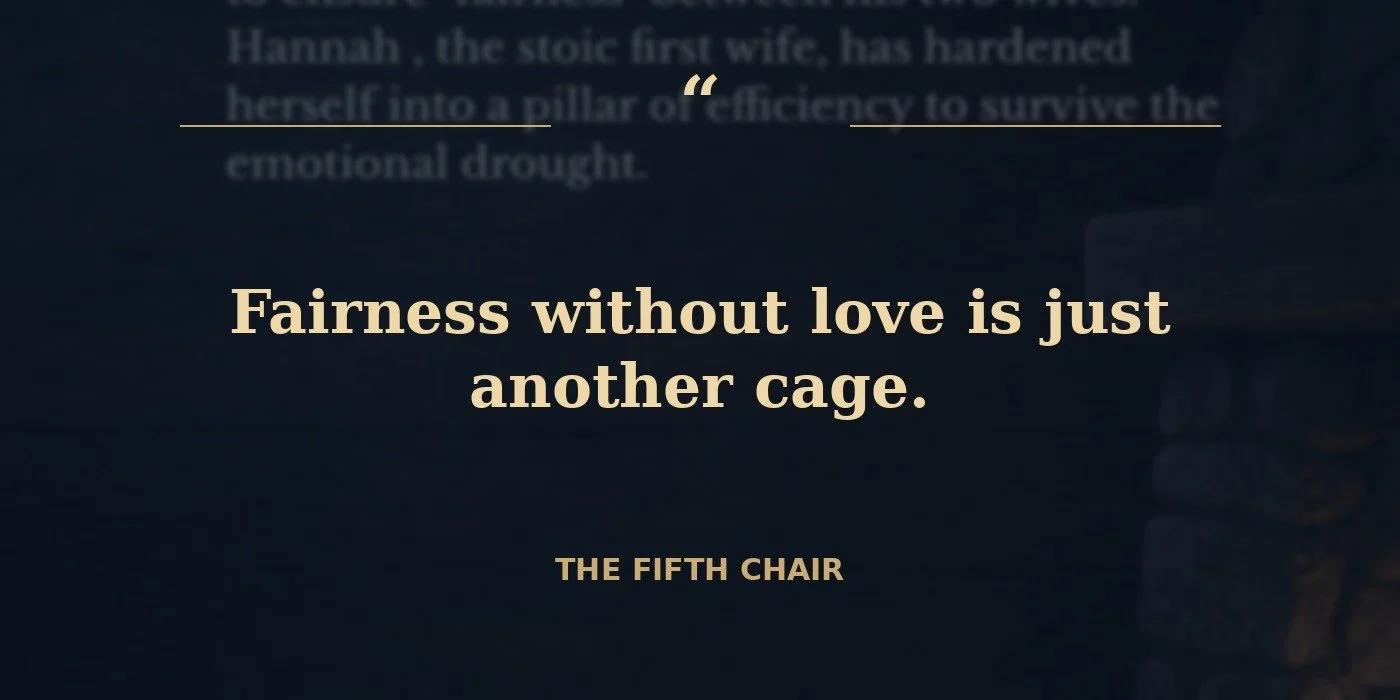
Quote graphic for The Fifth Chair reading Fairness without love is just another cage.

Fairness without love is just another cage.

The chair that changes the room

As winter tightens around the Ward homestead, the family begins to face a truth Elias can no longer calculate away: a home built on perfect distribution is not the same thing as a home built on love.

The fifth chair begins as a symbol of order, another attempt to solve the household by structure, balance, and design. But the more the family struggles, the more that chair becomes something else.

Not a seat for another obligation.

Not a monument to control.

A place for the voice that has been missing.

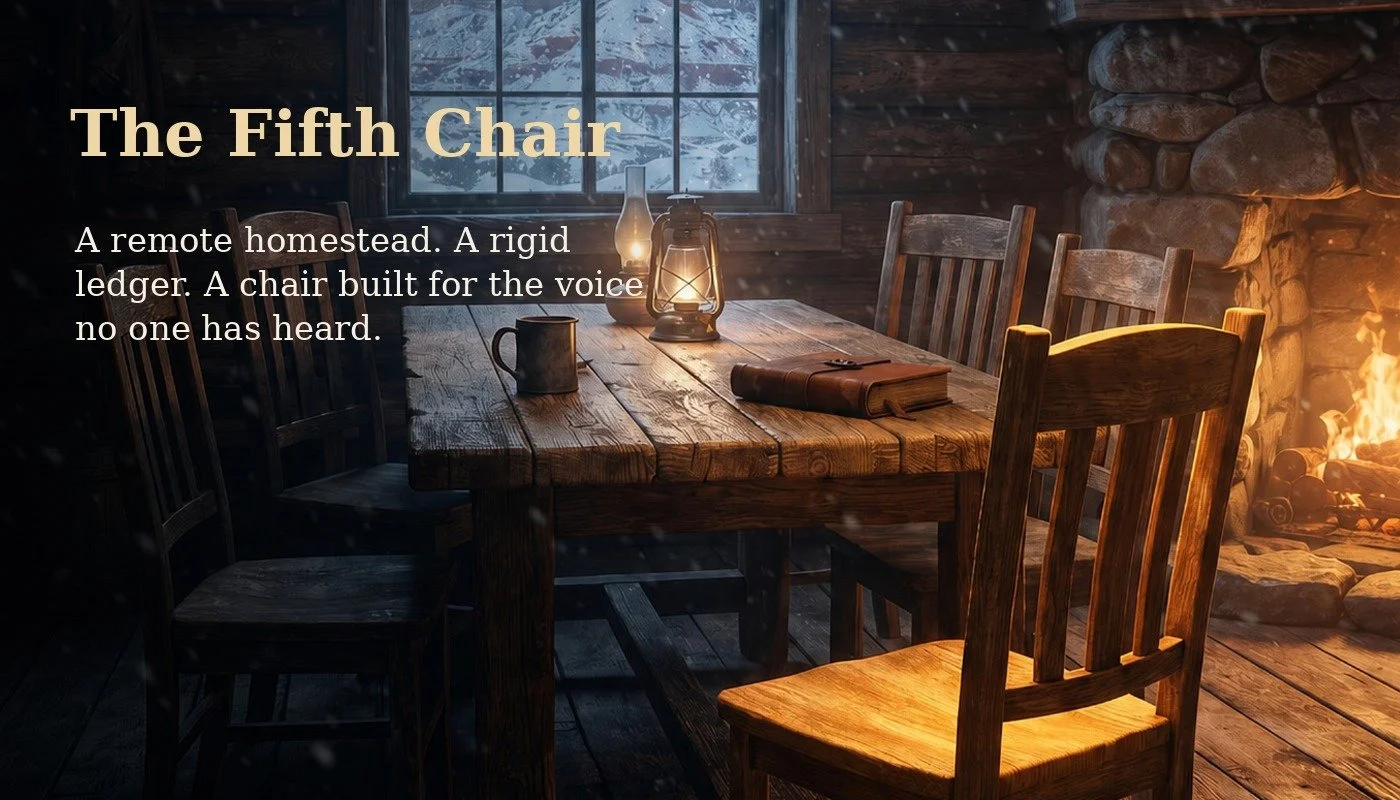
Promotional image for The Fifth Chair showing a dim, lantern-lit cabin table with chairs and the line A remote homestead. A rigid ledger. A chair built for the voice no one has heard.

A remote homestead. A rigid ledger. A chair built for the voice no one has heard.

For readers who like emotional, character-driven romance

The Fifth Chair is for readers who enjoy:

Plural marriage romance with deep emotional stakes

Cedar Mesa family drama and high-desert atmosphere

Slow-burn healing inside a complicated household

A stern, wounded husband learning the difference between management and love

Strong women who have been quiet too long

Themes of covenant, agency, forgiveness, stewardship, and rebuilding trust

A romance where the central question is not simply who gets loved, but whether love can become generous enough to stop keeping score

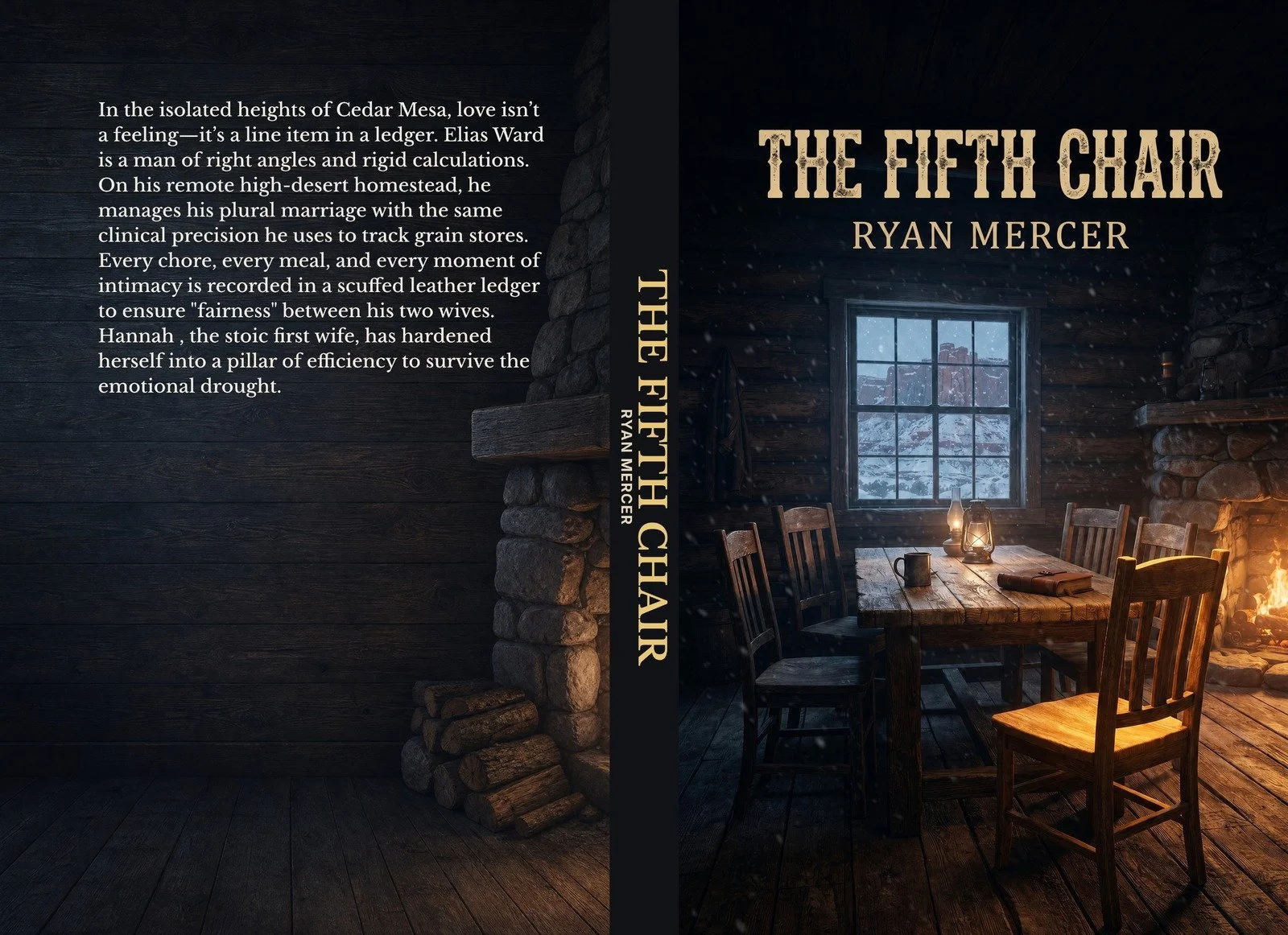
Full hardcover wrap for The Fifth Chair by Ryan Mercer, featuring back cover copy, spine, and a dark cabin table scene with lantern light and a snowy window.

Full hardcover wrap for The Fifth Chair.

Why this story matters

I am drawn to stories where the real conflict is not outside the house, but inside the everyday patterns people have learned to call normal.

The Fifth Chair lives in that space.

It is a story about a man who thinks precision can protect everyone from pain. It is a story about women who have been asked to endure quietly because the numbers say the arrangement is fair. It is a story about what happens when a family finally admits that order without tenderness is not peace.

Most of all, it is a story about making room.

Room for rest.

Room for honesty.

Room for a voice that was never meant to stay hidden in the corner.

Read The Fifth Chair

If you enjoy Cedar Mesa romance, complex plural households, emotional domestic tension, and stories about love becoming braver than control, I would be honored for you to read The Fifth Chair.

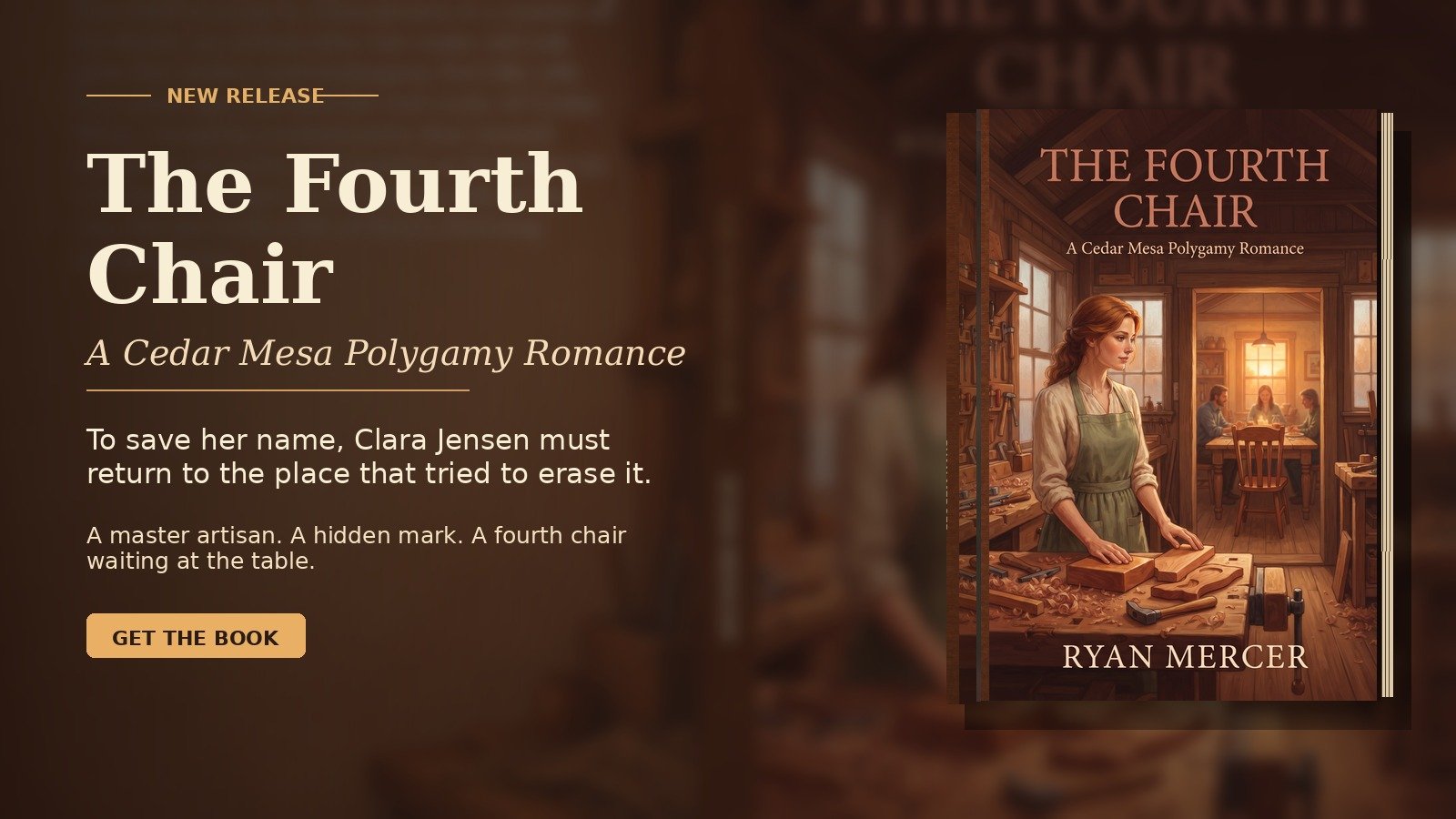
New Release: The Fourth Chair

A Cedar Mesa polygamy romance about Clara Jensen, a master artisan who returns to the red rocks to protect her name, her craft, and the chair that may finally give her a place to belong.

What does it cost a woman to keep her name?

The Fourth Chair is a Cedar Mesa Polygamy Romance about Clara Jensen, a master of the finish whose hands can make old oak glow like amber and mahogany feel like silk. Five years ago, Clara fled the red rocks of Cedar Mesa and the expectations that tried to turn women into footnotes in someone else’s ledger. In the city, she built a life of fierce independence, cold workshops, and a signature she refused to surrender.

Then Cedar Mesa calls her back.

A schoolhouse commission offers Clara the money, visibility, and professional recognition she has been chasing. It also forces her back into the community she escaped, into a household with three chairs already set at the table, and into the orbit of Daniel Calder, a man whose quiet strength unsettles every defense she has built.

A story about craft, covenant, and the fear of disappearing

Clara does not come to Cedar Mesa looking for love.

She comes with her tool chest, her maker’s mark, and a plan to finish the work, sign every piece, and leave with her name intact.

But the Calder household is not what she expected.

Ruth offers warmth without ownership. Naomi offers professional kinship instead of competition. Daniel offers restraint, respect, and a kind of advocacy Clara does not know how to trust.

And waiting in the corner is the fourth chair.

Not just a seat.

Not just an invitation.

A question.

Can Clara belong without being erased?

About the book

The Fourth Chair blends intimate romance, family drama, woodworking imagery, and the emotional tension of a woman deciding whether love can be an expanding well instead of a cage.

Readers who enjoy character-driven romance, artisan heroines, slow-burn emotional stakes, plural household dynamics, and stories about women claiming their names will find Clara’s journey both tender and sharp-edged.

At its heart, this book asks a question that matters far beyond Cedar Mesa:

What if independence is not the absence of love, but the right to be fully seen inside it?

This book is for readers who like:

A strong, guarded heroine with a craft of her own

A romance built on respect, restraint, and emotional honesty

Warm domestic settings with high personal stakes

Woodworking, maker’s marks, schoolhouse commissions, and hidden signatures

Plural marriage romance centered on choice, covenant, and belonging

Stories where a family must learn to make room without swallowing the person they invite in.

Read The Fourth Chair

If Clara Jensen’s story speaks to you, I would be honored for you to read it, share it, and leave a review when you finish.

Reviews help the book reach the readers who are looking for emotional romance, complex family dynamics, and a heroine who refuses to let her name be sanded away.

ComMarker Omni X UV Laser Engraver Review: The Future of Precision Engraving

A New Era of Laser Engraving

The ComMarker Omni X isn’t just another desktop laser — it’s the world’s first smart UV laser engraver, combining industrial-grade precision with an elegant all-metal design and smart features.

Unlike diode or CO₂ lasers, the Omni X uses a 355 nm UV laser beam to deliver micron-level engraving accuracy (0.0019 mm), unlocking new creative possibilities for jewelry, glass, metal, and even edible projects like chocolate engraving.

⚙️ Stand-Out Features

1. LiDAR Auto Focus
No more manual adjustments — Omni X uses a LiDAR ranging system for micron-perfect focus on every surface.

2. ZeroBurn™ Technology
A cold engraving process that prevents scorching on wood, leather, and acrylic, delivering clean edges and crisp details.

3. 3D Crystal Interior Engraving
Engrave inside glass or crystal cubes to create floating 3D designs — the kind you’d normally see in high-end gift shops.

4. Class-1 Safety Design
The fully enclosed OD 5+ UV-blocking shield eliminates the need for goggles and keeps users safe during operation.

5. ColdFront™ 2.0 Thermal System
Keeps the laser cool under continuous operation, preventing heat distortion and extending machine life.

6. SpeedMax™ Motion System
Engraves at up to 10,000 mm/s, making this one of the fastest consumer-grade UV engravers available.

🧰 Bundle Options

Basic Bundle – $3,999
Includes: Omni X (6 W) machine, two field lenses (70 mm & 150 mm), foot switch, lifting platform, material pack, and safety goggles.

Rotary Bundle – $4,259
Includes everything in the Basic Bundle + the R5 Multi-Functional Rotary for curved-surface engraving (tumblers, rings, etc.).

Slider Bundle – $4,499
Includes everything in the Basic Bundle + a Slide Extension, expanding the working area to 150 × 400 mm (6 W) or 250 × 400 mm (12 W).

Ultimate Bundle – $5,089
Includes everything from the Rotary and Slider Bundles + a 100 W fume extractor for cleaner workshop operation.

Creative Applications

  • 3D Crystal Cubes: Engrave photos or logos inside crystal for gorgeous keepsakes.

  • Jewelry & Metals: Engrave gold, silver, stainless steel, and platinum with micro detail.

  • Wood & Leather: ZeroBurn™ tech ensures no scorch marks.

  • Glass & Acrylic: Clean lines with no cracks or haze.

  • Food Art: Yes — it engraves chocolate without melting it.

Software & Connectivity

  • ComMarker Studio: Self-developed platform with remote OTA updates and powerful control.

  • LightBurn Compatible: Works with LightBurn for users who prefer its workflow.

  • USB & Wi-Fi Control: Supports offline jobs and remote management.

⚠️Things to Know⚠️

The ComMarker Studio software is still maturing and LightBurn compatibility is improving, but the hardware itself is exceptional. If you want cutting-edge precision and a safety-first design, the Omni X is a solid investment for both professionals and serious makers.

Final Thoughts

The ComMarker Omni X brings a new level of accuracy and safety to desktop engraving. With LiDAR autofocus, ZeroBurn™ cold engraving, and industrial-grade build quality, it’s a machine that proves UV laser engraving is ready for the mainstream creator market.

👉 Check the latest pricing and bundle options here:
ComMarker Omni X UV Laser Engraver

OMTech Solis Duo Review – One Machine, Two Lasers, Unlimited Potential

When OMTech announced the Solis Duo, it immediately caught the attention of makers, small business owners, and engraving enthusiasts. Why? Because it brings together two of the most powerful laser technologies — fiber and diode — in a single, safety-certified machine. Whether you work with metals, wood, acrylic, leather, or plastics, this all-in-one system means you’ll never need to choose between precision and versatility again.

👉 See the full lineup here: OMTech Solis Duo Pre-Order Page

Dual-Laser Power in One Compact Machine

The Solis Duo features two distinct laser sources working together:

  • A 1064 nm infrared fiber laser for metals like stainless steel, brass, titanium, and copper.

  • A 455 nm blue diode laser for organic materials such as wood, leather, rubber, and acrylic.

Switching between the two lasers is instant and effortless. You can go from engraving a metal keychain to etching a wooden plaque without retooling or changing your setup. It’s a true hybrid laser experience built for speed and convenience.

Precision, Speed, and Safety

The Solis Duo is built from 6061 aluminum alloy, ensuring stability and long-term durability.
Each model delivers up to 10,000 mm/s engraving speed with 0.002 mm accuracy, producing fine details that rival industrial machines.

The fully enclosed body is Class 1 FDA-certified, making it safe to operate in workshops, classrooms, or even home studios. This combination of speed, safety, and reliability makes it a professional-grade system in a desktop footprint.

Built for Creativity and Productivity

Depending on your needs, OMTech offers three configurations of the Solis Duo:

  • 20W Fiber + 20W Diode – Manual focus

  • 30W Fiber + 20W Diode – Autofocus

  • 50W Fiber + 40W Diode – Autofocus and top-tier performance

All three models share a 9.8 × 9.8 inch work area, which is already larger than many competitors. If you need more space, you can add the optional conveyor system to extend your workspace up to 9.8 × 35.4 inches, perfect for long designs or production runs.

Pair it with the rotary axis attachment, and you’ll be engraving cylindrical objects like tumblers, mugs, or rings with precision. Combined with an estimated 100,000-hour laser life, this is a machine designed for serious, long-term use.

Smart Features for Modern Makers

The Solis Duo integrates several features that make operation seamless:

  • A 16 MP HD camera gives you real-time visual alignment, making precise positioning fast and easy.

  • Autofocus capability (on the 30W and 50W models) ensures consistent results across materials.

  • Full compatibility with LightBurn and OMTech Lab software means you can design and engrave using the tools you already love.

From the first project to your hundredth, the user experience stays intuitive, efficient, and accurate.

What Materials It Can Engrave

The beauty of the Solis Duo is its flexibility. Here’s what you can expect:

  • Metals (Fiber Laser): Stainless steel, brass, copper, aluminum, titanium — great for deep engraving, marking, and serial coding.

  • Organics (Diode Laser): Wood, leather, rubber, acrylic, and coated materials — ideal for engraving, cutting, or decorative design.

  • Mixed Materials: Combine both beams in creative workflows for hybrid projects like metal-and-wood signage or leather-and-acrylic branding tags.

This makes it an ideal tool for jewelers, small manufacturers, Etsy shop owners, educators, and custom product designers who want a single machine for multiple applications.

Final Thoughts – Who It’s For

If you’ve ever been torn between buying a fiber or diode laser, the OMTech Solis Duo finally makes that decision easy. It’s a hybrid powerhouse that blends industrial precision with the creative freedom of a diode system.

It’s perfect for:

  • Small businesses producing personalized products

  • Makers and content creators upgrading from entry-level lasers

  • Schools and workshops needing a safe, enclosed setup

  • Professionals who demand versatility without sacrificing performance

This is more than a new laser — it’s the next step in compact engraving innovation.

👉 Learn more or pre-order your Solis Duo here:
https://omtech.com/pages/omtech-solis-duo-pre-order?sca_ref=6800540.7IQun8FJWu&utm_source=affiliate&utm_medium=kols&utm_campaign=ryan-mercer

Affiliate Disclaimer

This post contains affiliate links. If you purchase through one of these links, I may earn a small commission at no extra cost to you. This helps support the channel and future reviews. Thank you for your support!

Wow

I've got a meeting in a few days and I was trying to think of things I've accomplished in my life, and where I want to go in the future, what my goals are. I also recently just hit my 12th anniversary at FedEx Trade Networks and then it hit me... it has been a bit over 11 and a half years since The Wall Street Journal talked to me and Forbes interviewed me for their 'video network' on YouTube. Looking back at both of these things is incredibly cringe-worthy. 

Here's the WSJ article, which is unfortunately behind a pay wall https://www.wsj.com/articles/SB116441076273232312

And here is the Forbes interview, yikes! https://www.youtube.com/watch?v=SLznUBgm8S4?rel=0

I wish these would cease to exist but since they probably won't I might as well embrace them, or at least remember them ha!