Introducing The Republic of Exiles, Book One of The Concord Series
Some people escape history. Others build what comes next.
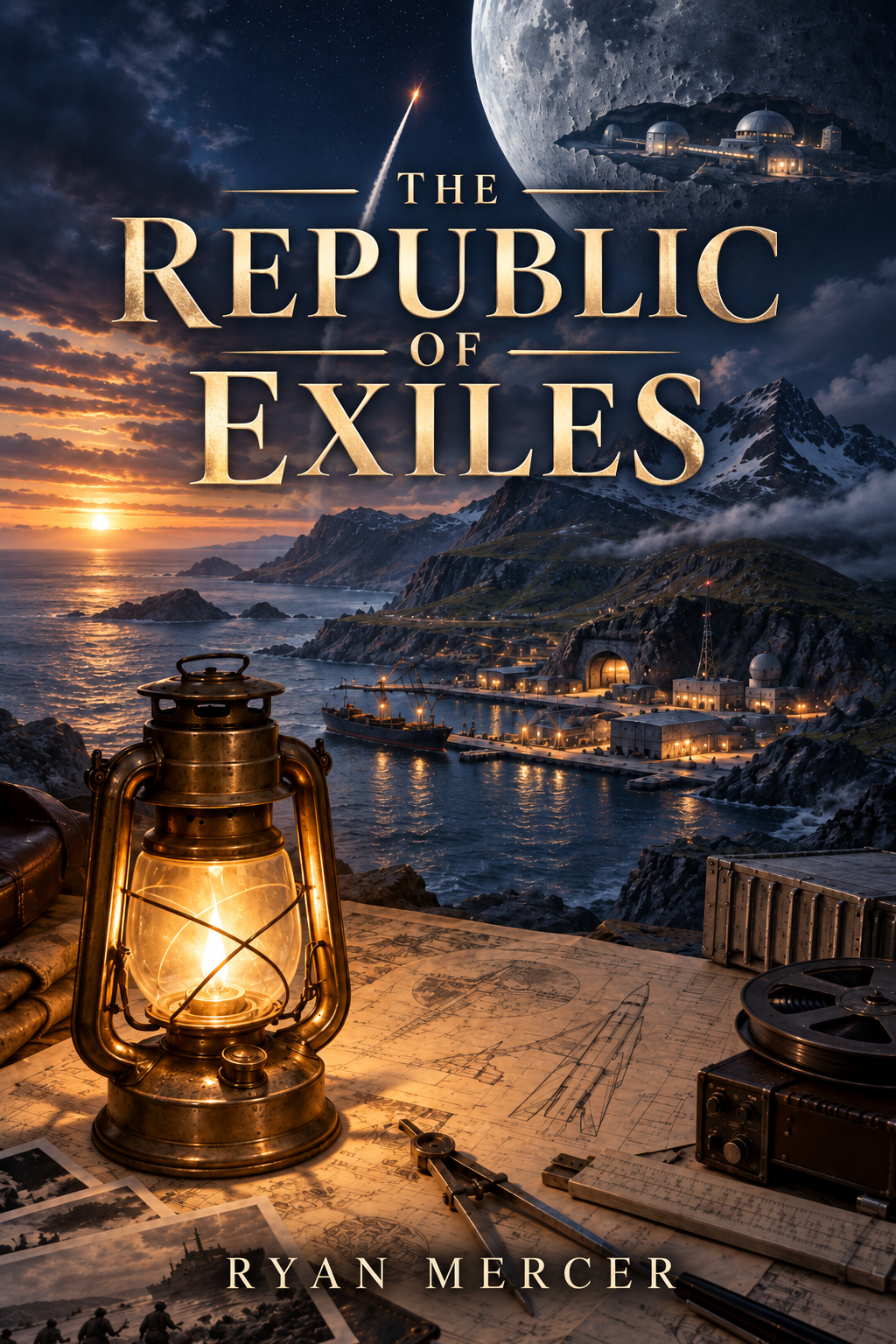
I am excited to introduce The Republic of Exiles, the first novel in The Concord Series, a sweeping alternate-history and hard science fiction saga spanning World War II, the Cold War, the Space Race, and humanity’s first permanent steps beyond Earth.
The story begins in 1943, when American industrialist Thomas Lyle becomes convinced that the end of World War II will not bring lasting peace. Germany may be defeated, but its scientists, engineers, factories, and research programs are already becoming prizes in a new struggle between the United States and the Soviet Union.
Thomas believes that another war is coming, one armed with rockets, nuclear weapons, surveillance systems, and technologies capable of placing the entire world at risk.
His answer is Project Lantern.
A civilization built from the people history overlooks
Project Lantern is a clandestine recruitment and rescue network operating across wartime Europe. Its mission is not limited to collecting famous scientists.
Thomas Lyle and physician Miriam Rosenfeld understand that a new civilization cannot be built by a handful of celebrated geniuses. It also needs machinists, technicians, draftsmen, nurses, teachers, farmers, accountants, translators, toolmakers, production supervisors, and families.
Project Lantern begins extracting entire technical communities before they can be captured, imprisoned, prosecuted, or absorbed into the programs of the victorious powers.
Some of the recruits are refugees.
Some are resistance members.
Some worked for governments they hated because refusing would have meant imprisonment or death.
Others carry histories that are far more difficult to excuse.
Every rescue forces Project Lantern to confront the same question: Who deserves a second chance, and who has done too much harm to be welcomed into a new society?
The rise of the Concord
The refugees are transported to the remote San Telmo Archipelago, where they establish a hidden settlement under the cover of a mining and shipping development project.
What begins as a temporary refuge gradually becomes a country.
The residents call their new society the Concord, an independent civilization that claims no connection to the governments, borders, and rivalries of the world they left behind.
Its secret leadership, the Long Horizon Committee, promises that strict control is only temporary. Elections, open records, freedom of movement, and full self-government can come later, once the settlement is safe.
But temporary powers have a way of becoming permanent.
The first generation remembers war, occupation, genocide, and displacement. Many are willing to accept secrecy in exchange for survival.
The generation born inside the Concord remembers none of those things. They do not see themselves as refugees waiting for the danger to pass. They see themselves as citizens of a country that refuses to let them govern it.
Financing a hidden nation
The Concord does not possess a magical source of wealth, alien technology, or limitless resources.
It finances itself through the Meridian Development Trust, a global network of corporations, foundations, shipping companies, research institutes, and patent-holding firms.
Meridian commercializes technologies that genuinely existed, or were close to existing, during the middle of the twentieth century. These include:
Magnetic tape recording
Industrial microwave systems
Refrigeration and freeze-drying
Transistorized hearing aids
Numerical-control machine tools
Solar cells
Standardized shipping containers
Office copying systems
Business computers
Semiconductor manufacturing
Desalination and water-recycling systems
Automated mining equipment
The public versions of these inventions remain only slightly ahead of real history. Meridian earns money by introducing products at the right moment, improving manufacturing quality, and building long-term service and licensing networks.
The Concord keeps its best designs for itself.
Its true advantage is not a single revolutionary invention. It is the ability to bring scientists, engineers, machinists, physicians, and manufacturers together decades earlier than they would have worked together in the outside world.
That advantage eventually gives birth to Hesperus, the Concord’s secret space program.
A different kind of space race
The American and Soviet space programs compete for public victories.
Hesperus has a different goal.
It does not want to plant a flag, take photographs, and return home. It wants to create a permanent human settlement beyond the reach of any Earth government.
Through offshore launch platforms, hidden tracking stations, automated cargo missions, compact computers, and closed-loop environmental systems, Hesperus begins building Somnium Station near the lunar south pole.
By the time Apollo 11 approaches the Moon in July 1969, twelve people are already living beneath the lunar surface.
They watch the public landing from a concealed station that the rest of humanity does not know exists.
But reaching the Moon does not solve the Concord’s problems.
It only gives those problems somewhere new to spread.
The lie beneath Hesperus
The Concord’s greatest technological achievement rests partly on the work of Dr. Konrad Weiss, a German propulsion specialist with expertise essential to the development of Hesperus.
Weiss was originally rejected by Project Lantern because of evidence connecting him to the exploitation and deaths of forced laborers.
Thomas Lyle rescued him anyway.
He gave Weiss a false identity, concealed his history, and allowed him to become one of the hidden architects of the Concord’s space program.
Thomas tells himself that saving Weiss allowed him to save thousands of others. Without Weiss, Hesperus might never have reached the Moon.
When the truth finally emerges, the Concord must decide whether its survival justifies the crimes committed in its name.
Security Director Anton Varga believes the answer is clear. The Concord is too important to be placed at risk by elections, public trials, or citizens who do not understand the threats surrounding them.
Miriam Rosenfeld, Hana Novák, Samuel Rosenfeld, and the generation raised inside the Concord believe something different.
A refuge that cannot trust its own people is not free.
A civilization built to escape tyranny cannot survive by reproducing it.
A story about more than reaching the Moon
Although The Republic of Exiles eventually reaches the lunar surface, this is not only a space-race novel.
It is also a story about recruitment, industrial development, family, memory, secrecy, and nation-building.
The book follows people trying to construct the practical foundations of a civilization:
How do refugees from hostile nations learn to live together?
Who writes the laws?
Who controls the factories?
Can a citizen choose to leave?
How much technology can be sold without exposing the society that created it?
Can scientific knowledge be separated from the crimes of the people who produced it?
What happens when a government created for an emergency refuses to surrender its emergency powers?
Does escaping the old world make it possible to build a better one?
The Concord is neither a perfect utopia nor a simple dystopia.
It provides safety, education, medical care, housing, and opportunity to people who might otherwise have died or disappeared into the machinery of the Cold War.
It also survives through forged identities, hidden corporations, surveillance, restricted movement, and an unelected leadership convinced that it knows what is best for everyone.
The people of the Concord must decide which parts of their society are worth preserving and which parts must be dismantled before they become permanent.
The beginning of The Concord Series
The Republic of Exiles covers the creation of Project Lantern, the rise of the Meridian Development Trust, the founding of the Concord, the development of Hesperus, and the establishment of Somnium Station.
The novel culminates during the Apollo 11 landing, when the hidden residents of Somnium watch Neil Armstrong and Buzz Aldrin take humanity’s first public steps on another world.
Beyond them, another project is already beginning.
The first experimental component of Barsoom One, the Concord’s proposed Mars expedition, has reached lunar orbit.
Future books in The Concord Series will explore the growth of Somnium Station, the political relationship between Earth and the Moon, the growing risk of discovery, and the attempt to build a spacecraft capable of carrying human beings to Mars.
The Concord escaped the nations of Earth.
Now it must determine what kind of civilization it will carry into space.