New Release: The Fifth Chair

What happens when love becomes something you can count, divide, rotate, and record?

The Fifth Chair is a Cedar Mesa Polygamy Romance about Elias Ward, a man who has mistaken fairness for tenderness. On his isolated high-desert homestead, Elias manages his plural marriage with rigid precision. Every chore, every meal, every duty, and every private obligation is written into a scuffed leather ledger so no one can accuse him of favoritism.

To Elias, the system is fair.

To the women living inside it, the system is slowly turning the house cold.

ront cover of The Fifth Chair by Ryan Mercer, showing a dark cabin interior with a table, lantern, fireplace, snowy window, and multiple wooden chairs.

The Fifth Chair by Ryan Mercer.

A story about fairness, silence, and the weight of being managed

Hannah, Elias’s first wife, has become the pillar of the household. She is steady, efficient, stoic, and exhausted. She knows the rhythms of the kitchen, the cellar, the winter stores, and the family ledger so well that no one seems to notice how much of herself has been buried beneath the work.

Leah, the second wife, moves through the Ward home like a shadow, carrying the scent of wool, lanolin, and long nights of labor. She has learned how to be quiet, how to take up less space, and how to survive inside a marriage where even intimacy has a place in the rotation.

And Elias believes he is doing the right thing.

He provides. He protects. He records. He balances.

But a ledger can only measure what is owed. It cannot measure loneliness. It cannot measure hunger for kindness. It cannot measure the grief of a woman who has been treated fairly and still feels unseen.
Quote graphic for The Fifth Chair reading Fairness without love is just another cage.

Fairness without love is just another cage.

The chair that changes the room

As winter tightens around the Ward homestead, the family begins to face a truth Elias can no longer calculate away: a home built on perfect distribution is not the same thing as a home built on love.

The fifth chair begins as a symbol of order, another attempt to solve the household by structure, balance, and design. But the more the family struggles, the more that chair becomes something else.

Not a seat for another obligation.

Not a monument to control.

A place for the voice that has been missing.
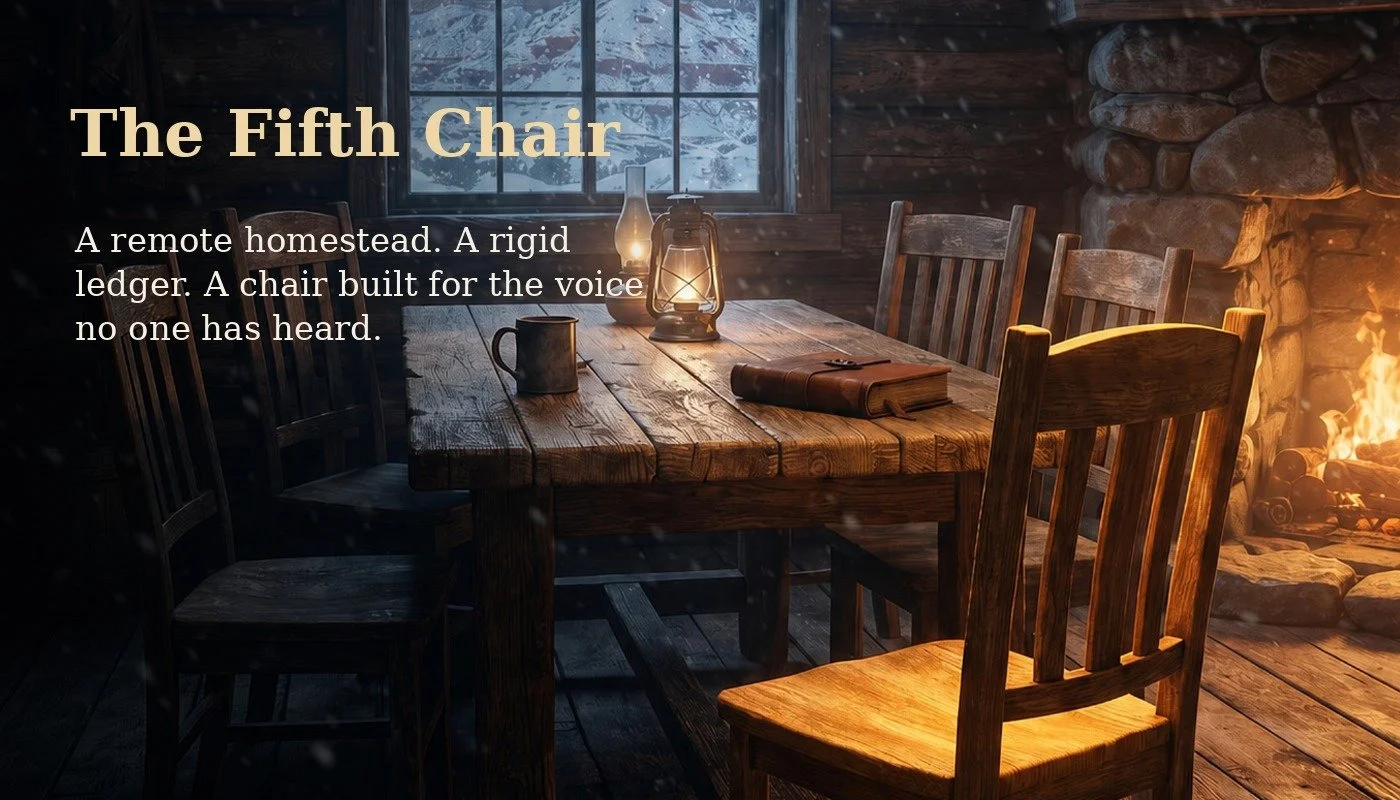
Promotional image for The Fifth Chair showing a dim, lantern-lit cabin table with chairs and the line A remote homestead. A rigid ledger. A chair built for the voice no one has heard.

A remote homestead. A rigid ledger. A chair built for the voice no one has heard.

For readers who like emotional, character-driven romance

The Fifth Chair is for readers who enjoy:

Plural marriage romance with deep emotional stakes

Cedar Mesa family drama and high-desert atmosphere

Slow-burn healing inside a complicated household

A stern, wounded husband learning the difference between management and love

Strong women who have been quiet too long

Themes of covenant, agency, forgiveness, stewardship, and rebuilding trust

A romance where the central question is not simply who gets loved, but whether love can become generous enough to stop keeping score

Full hardcover wrap for The Fifth Chair by Ryan Mercer, featuring back cover copy, spine, and a dark cabin table scene with lantern light and a snowy window.

Full hardcover wrap for The Fifth Chair.

Why this story matters

I am drawn to stories where the real conflict is not outside the house, but inside the everyday patterns people have learned to call normal.

The Fifth Chair lives in that space.

It is a story about a man who thinks precision can protect everyone from pain. It is a story about women who have been asked to endure quietly because the numbers say the arrangement is fair. It is a story about what happens when a family finally admits that order without tenderness is not peace.

Most of all, it is a story about making room.

Room for rest.

Room for honesty.

Room for a voice that was never meant to stay hidden in the corner.

Read The Fifth Chair

If you enjoy Cedar Mesa romance, complex plural households, emotional domestic tension, and stories about love becoming braver than control, I would be honored for you to read The Fifth Chair.
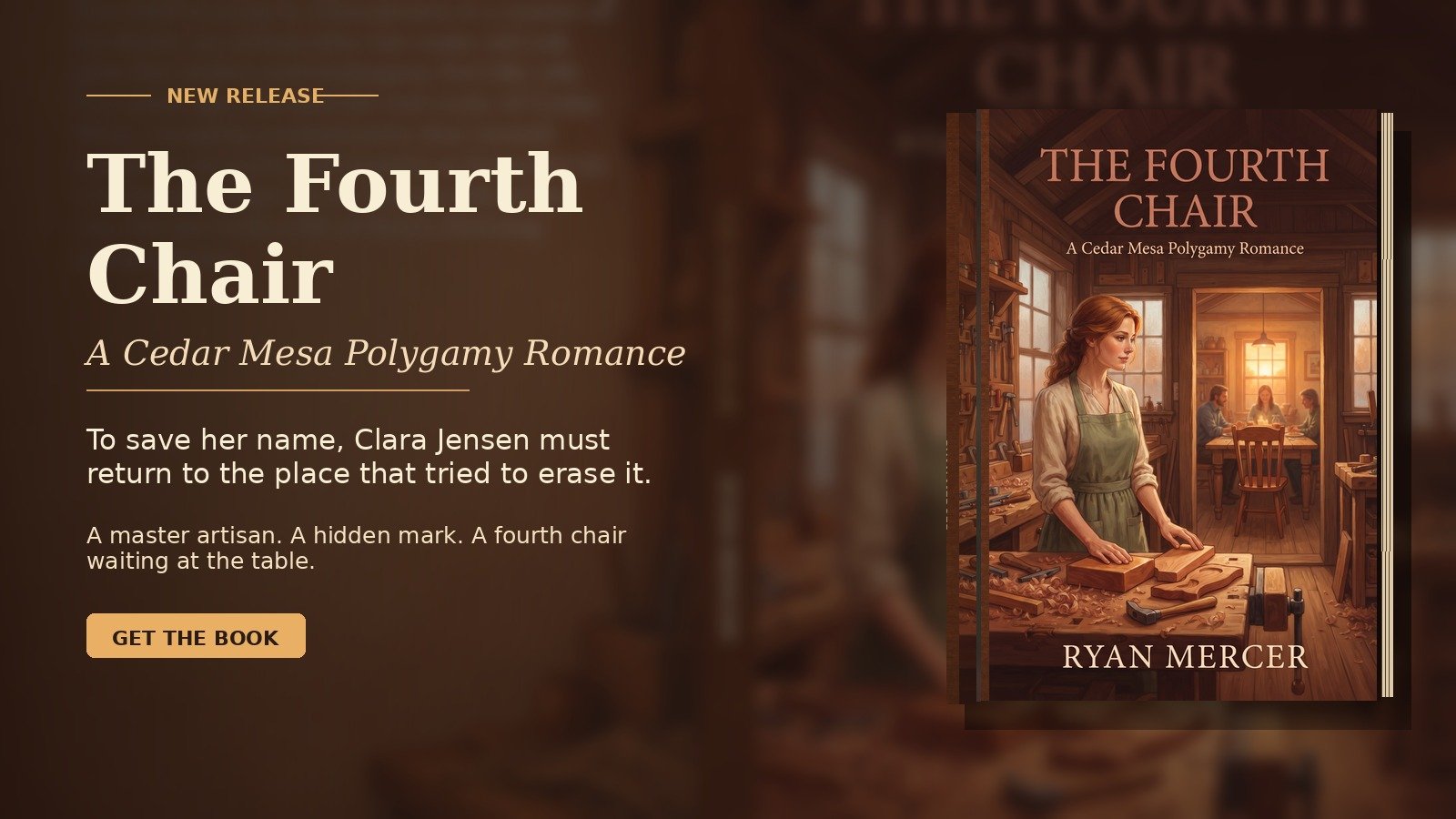

New Release: The Fourth Chair

A Cedar Mesa polygamy romance about Clara Jensen, a master artisan who returns to the red rocks to protect her name, her craft, and the chair that may finally give her a place to belong.

What does it cost a woman to keep her name?

The Fourth Chair is a Cedar Mesa Polygamy Romance about Clara Jensen, a master of the finish whose hands can make old oak glow like amber and mahogany feel like silk. Five years ago, Clara fled the red rocks of Cedar Mesa and the expectations that tried to turn women into footnotes in someone else’s ledger. In the city, she built a life of fierce independence, cold workshops, and a signature she refused to surrender.

Then Cedar Mesa calls her back.

A schoolhouse commission offers Clara the money, visibility, and professional recognition she has been chasing. It also forces her back into the community she escaped, into a household with three chairs already set at the table, and into the orbit of Daniel Calder, a man whose quiet strength unsettles every defense she has built.

A story about craft, covenant, and the fear of disappearing

Clara does not come to Cedar Mesa looking for love.

She comes with her tool chest, her maker’s mark, and a plan to finish the work, sign every piece, and leave with her name intact.

But the Calder household is not what she expected.

Ruth offers warmth without ownership. Naomi offers professional kinship instead of competition. Daniel offers restraint, respect, and a kind of advocacy Clara does not know how to trust.

And waiting in the corner is the fourth chair.

Not just a seat.

Not just an invitation.

A question.

Can Clara belong without being erased?

About the book

The Fourth Chair blends intimate romance, family drama, woodworking imagery, and the emotional tension of a woman deciding whether love can be an expanding well instead of a cage.

Readers who enjoy character-driven romance, artisan heroines, slow-burn emotional stakes, plural household dynamics, and stories about women claiming their names will find Clara’s journey both tender and sharp-edged.

At its heart, this book asks a question that matters far beyond Cedar Mesa:

What if independence is not the absence of love, but the right to be fully seen inside it?

This book is for readers who like:

A strong, guarded heroine with a craft of her own

A romance built on respect, restraint, and emotional honesty

Warm domestic settings with high personal stakes

Woodworking, maker’s marks, schoolhouse commissions, and hidden signatures

Plural marriage romance centered on choice, covenant, and belonging

Stories where a family must learn to make room without swallowing the person they invite in.

Read The Fourth Chair

If Clara Jensen’s story speaks to you, I would be honored for you to read it, share it, and leave a review when you finish.

Reviews help the book reach the readers who are looking for emotional romance, complex family dynamics, and a heroine who refuses to let her name be sanded away.

Introducing The Third Chair: A Cedar Mesa Polygamy Romance

A warm, emotional romance about plural marriage, sister-wife trust, childlessness, consent, and the courage it takes to make room at the table without asking anyone to disappear.

Introducing The Third Chair

Some love stories begin with a kiss.

Some begin with a look across a crowded room.

This one begins with a chair.

The Third Chair: A Cedar Mesa Polygamy Romance is the first book in my Cedar Mesa series, a warm contemporary romance set in a high-desert community where faith, family, privacy, and plural marriage shape the rhythms of everyday life.

At the heart of the story are Daniel and Ruth Calder, a devoted couple who have spent eight loving years together in a quiet, childless home. Their marriage is steady. Their bond is real. But they both believe their family may still be called to grow.

Then Naomi Hale steps into their lives.

Naomi is a gifted woodworker with steady hands, a sharp mind, and a heart that has spent too long being valued for what it can do rather than for who she truly is. When Daniel and Ruth begin courting her as a potential second wife, Naomi sees a chance at love, belonging, and a life of her own.

But nothing about making room for another wife is simple.

Ruth wants to welcome Naomi with grace, but she quietly fears being diminished in the home she helped build. Naomi is drawn to the Calders, but she refuses to be treated as the answer to their childlessness. Daniel wants to lead well, but he must learn that love cannot be protected by making decisions for the women he loves. It has to be built with them.

This is a romance about the emotional work of making space.

A place at the table.

A voice in the family.

A love chosen freely, carefully, and honestly.

What kind of romance is The Third Chair?

This is a warm, character-driven romance with a family saga feel. It is not dark romance. It is not erotica. It is not a sensationalized look at plural marriage.

It is a tender, domestic story about three consenting adults trying to build a family without letting fear, jealousy, fertility expectations, or community pressure decide the shape of their future.

Expect:

Slow-burn courtship
Sister-wife tension and trust
A tender existing marriage
Faith-shaped domestic life
Red-rock mesas, cedar sawdust, harvest light, and kitchen-table conversations
Infertility handled with dignity
Warm romantic tension
Meaningful touch and tender kisses
Adult family councils where every voice matters
A hopeful ending rooted in consent, belonging, and shared stewardship

Why Cedar Mesa?

Cedar Mesa is a quiet red-rock community in the rural Utah-Arizona borderlands, close to the land and mostly outside public attention. It is a place of orchards, workshops, gardens, schoolrooms, Sunday gatherings, family kitchens, and worn wooden tables where the most important conversations happen after the dishes are cleared.

I wanted Cedar Mesa to feel intimate and lived-in, not like a caricature or a scandal headline.

The people here are sincere. Imperfect. Sometimes too private. Sometimes too traditional. Often tender in ways they do not always know how to express. They are trying to live their beliefs while learning that faith does not have to mean silence, and leadership does not have to mean control.

The question at the heart of the book

Can love expand without making anyone smaller?

That question follows Ruth, Naomi, and Daniel from the first careful courtship conversation to the moment the third chair appears in the Calder kitchen.

For Ruth, the question is: Can another wife enter the family without erasing the marriage she and Daniel already share?

For Naomi, the question is: Can she be chosen for her heart, her mind, and her spirit, not for the children others hope she might someday have?

For Daniel, the question is: Can he become the kind of husband who listens before deciding, even when listening means admitting he was wrong?

The answer does not come all at once.

It comes through harvest work, quiet walks, hard conversations, awkward silences, honest apologies, and the courage to sit down at the table together.

Who should read this book?

You may enjoy The Third Chair if you like:

Contemporary romance with emotional depth
Small-town or close-community family sagas
Plural marriage and sister-wife dynamics
Stories about faith, consent, and chosen family
Gentle but high-stakes domestic drama
Romance that is sensual without being explicit
Characters who grow through conversation, tenderness, and hard-earned trust

If you are fascinated by plural-family stories but want something warmer, more romantic, and more character-centered, this book was written for you.

Read The Third Chair

The Third Chair: A Cedar Mesa Polygamy Romance is available now.

One table. Three chairs. A love chosen one voice at a time.