Oops you broke it

Heh, so yeah.. don't trust your compass, or any magnetic based guidance system for that matter.


The Earth's magnetic field is changing at an increasing rate, throwing off airports and altering the aurora borealis -- and its effect on ordinary compasses could mean the difference between homeward bound and hopelessly lost.

Earth’s northernmost magnetic point -- or magnetic north -- is distinct from its geographic North Pole, and scientists have long known that the magnetic poles are on the move.

But the magnetic poles have been moving faster lately, sliding towards Siberia at 34 miles per year at a speed that's accelerated 36 percent over the last 10 years, according to the United States Geological Survey, or USGS.

Since compasses rely on magnetic north to point you in the right way up the trail, the average $2-dollar model could very well point you in the wrong direction. Depending on location and journey length, unaware hikers or boaters could find themselves hundreds of miles off course if they don’t calibrate for the shift, experts said.

See the rest HERE

Personal Submarine Becomes Reality

I WANT ONE! Someone buy me one! NOW!


Forget jetpacks, hoverboards and beer hats -- the ultimate toy has always been something that's obvious, yet up until now, has seemed to be curiously avoided by leisure industry manufacturers -- personal submarines.

First widely used during World War I, submarines have been around for quite a while but these machines were cramped, uncomfortable, and difficult to navigate. Moreover, the vehicles didn't seem suited to personal use, aside from this effort from a Chinese farmer last year.

Then suddenly, in the last two years, there's been a rash of the ultimate escape vehicles hitting the market consumer market, culminating with the debut of Raonhaje's EGO at a boat show in Miami last week.

Unlike the dinky uBoatWorx submersibles and awkward Ocean Pearl, the EGO looks like what a proper undersea exploration lab should look like while doubling as a personal mobile island.


See the rest HERE


China blocks access to LinkedIn

Because, God forbid you let your people find jobs they'd like more... so that they'd be more productive, and improve your country!


(Fast Company) -- Users in China are reporting that access to LinkedIn has been blocked throughout the country. By all indications, it seems that the popular career networking site has run afoul of the country's infamous Great Firewall.

According to LinkedIn's Hani Durzy, the company is aware of a blockage in China and is "currently in the process of investigating the situation further."

The shutdown follows days of calls for a "Jasmine Revolution" in China, on the model of the Tunisian and Egyptian revolutions. Access to Twitter and Facebook has been blocked throughout China for some time; Chinese internet users seeking to use Twitter have been forced to access the site through difficult-to-use Virtual Private Networks (VPNs).

See the rest HERE

Last U.S. World War I veteran dies

A generation is lost to us... with this having happened this weekend, I urge all of you to speak to those you know that are... older... and get them to share their stories with you. Record, video tape, write down their stories and preserve them. Share them in blogs, on youtube, anywhere... just preserve their stories.


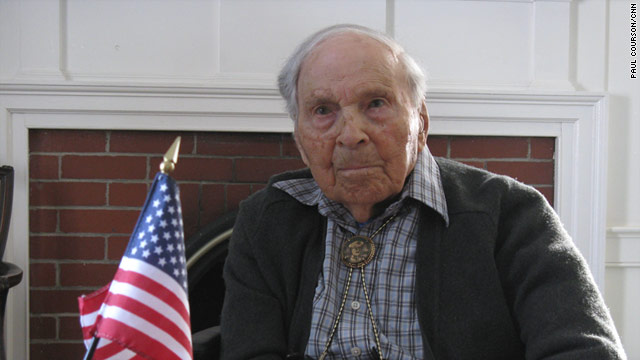
Washington (CNN) -- Frank Buckles, the last U.S. World War I veteran, has died, a spokesman for his family said Sunday. He was 110.

Buckles "died peacefully in his home of natural causes" early Sunday morning, the family said in a statement sent to CNN late Sunday by spokesman David DeJonge.

Buckles marked his 110th birthday on February 1, but his family had earlier told CNN he had slowed considerably since last fall, according his daughter Susannah Buckles Flanagan, who lives at the family home near Charles Town, West Virginia.

Buckles, who served as a U.S. Army ambulance driver in Europe during what became known as the "Great War," rose to the rank of corporal before the war ended. He came to prominence in recent years, in part because of the work of DeJonge, a Michigan portrait photographer who had undertaken a project to document the last surviving veterans of that war.


See the rest HERE

World's first anti-laser demonstrated

Heh, this is awesome.

Much to the distaste of James Bond villains everywhere, scientists from Yale University recently demonstrated not a new, more powerful type of laser, but actually its opposite – the world’s first anti-laser. The device receives incoming beams of light, which interfere with one another in such a way as to cancel each other out. It could apparently have valuable applications in a number of technologies, such as optical computing and radiology.

Lasers work by using a “gain medium,” often gallium arsenide or some other semiconductor, to produce light waves with the same frequency and amplitude. These waves, which are in step with one another, make up a focused beam of coherent light.

By contrast, the anti-laser utilizes a silicon wafer “loss medium.” When two laser beams were shone into a cavity containing that wafer, it aligned the light waves so that they became “perfectly trapped,” causing them to ricochet back and forth until they were absorbed and transformed into heat.

The anti-laser, officially known as a coherent perfect absorber (CPA), is about one centimeter across, and capable of absorbing 99.4 percent of incoming light. According to Yale physicist A. Douglas Stone, however, the current model is merely a proof-of-concept. He believes that future versions should be able to absorb 99.999 percent of the light, and could be built as small as six microns – approximately one-twentieth the width of a human hair. The current CPA is also limited to absorbing near-infrared light, but Stone believes that by altering the cavity and the loss medium, future versions should be able to handle visible and infrared light.


See therest HERE

Cosmic census determines there are LOTS of planets

SAWEEEEEET!!!!


Scientists have estimated the first cosmic census of planets in our galaxy and the numbers are astronomical: at least 50 billion planets in the Milky Way.

At least 500 million of those planets are in the not-too-hot, not-too-cold zone where life could exist. The numbers were extrapolated from the early results of NASA's planet-hunting Kepler telescope.

Kepler science chief William Borucki says scientists took the number of planets they found in the first year of searching a small part of the night sky and then made an estimate on how likely stars are to have planets. Kepler spots planets as they pass between Earth and the star it orbits.

So far Kepler has found 1,235 candidate planets, with 54 in the Goldilocks zone, where life could possibly exist. Kepler's main mission is not to examine individual worlds, but give astronomers a sense of how many planets, especially potentially habitable ones, there are likely to be in our galaxy. They would use the one-four-hundredth of the night sky that Kepler is looking at and extrapolate from there.


See the rest HERE


Researchers aim to 'print' human skin

I heard about this a few weeks ago on Coast to Coast AM. All I can say is I love the time we live in, all these awesome tech developments all the time. Who would have thought we'd be printing human skin with basically inkjet printers!


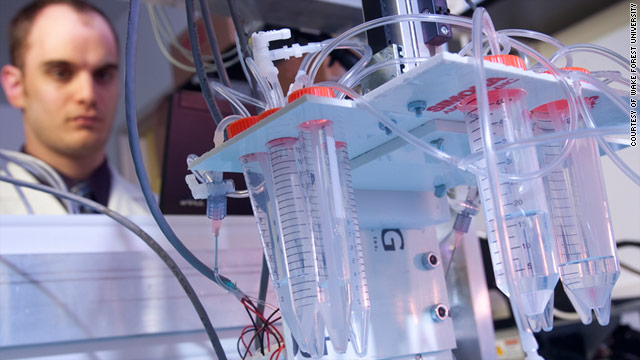
CNN) -- Researchers are developing a specialized skin "printing" system that could be used in the future to treat soldiers wounded on the battlefield.

Scientists at the Wake Forest Institute for Regenerative Medicine were inspired by standard inkjet printers found in many home offices.

"We started out by taking a typical desktop inkjet cartridge. Instead of ink we use cells, which are placed in the cartridge," said Dr. Anthony Atala, director of the institute.

The device could be used to rebuild damaged or burned skin.

The project is in pre-clinical phases and may take another five years of development before it is ready to be used on human burn victims, he said.

Other universities, including Cornell University and the Medical University of South Carolina, Charleston, are working on similar projects and will speak on the topic on Sunday at the American Association for the Advancement of Science conference in Washington. These university researchers say organs -- not just skin -- could be printed using similar techniques.


See the rest HERE