9,271.66665 jigawatts Marty (1.21 gigawatts Marty)

So you know for years now that company in Texas has been making DeLorean DMC-12's with OEM parts from the original DMC-12's on a per-order basis... in 2013 they'll be doing the same but as an electric model. 1.21 jigawatt MARTY!

See the article about the electric DeLorean HERE

So I did some math... if someone makes a Mr. Fusion... and you use one can of beer... the potential energy...
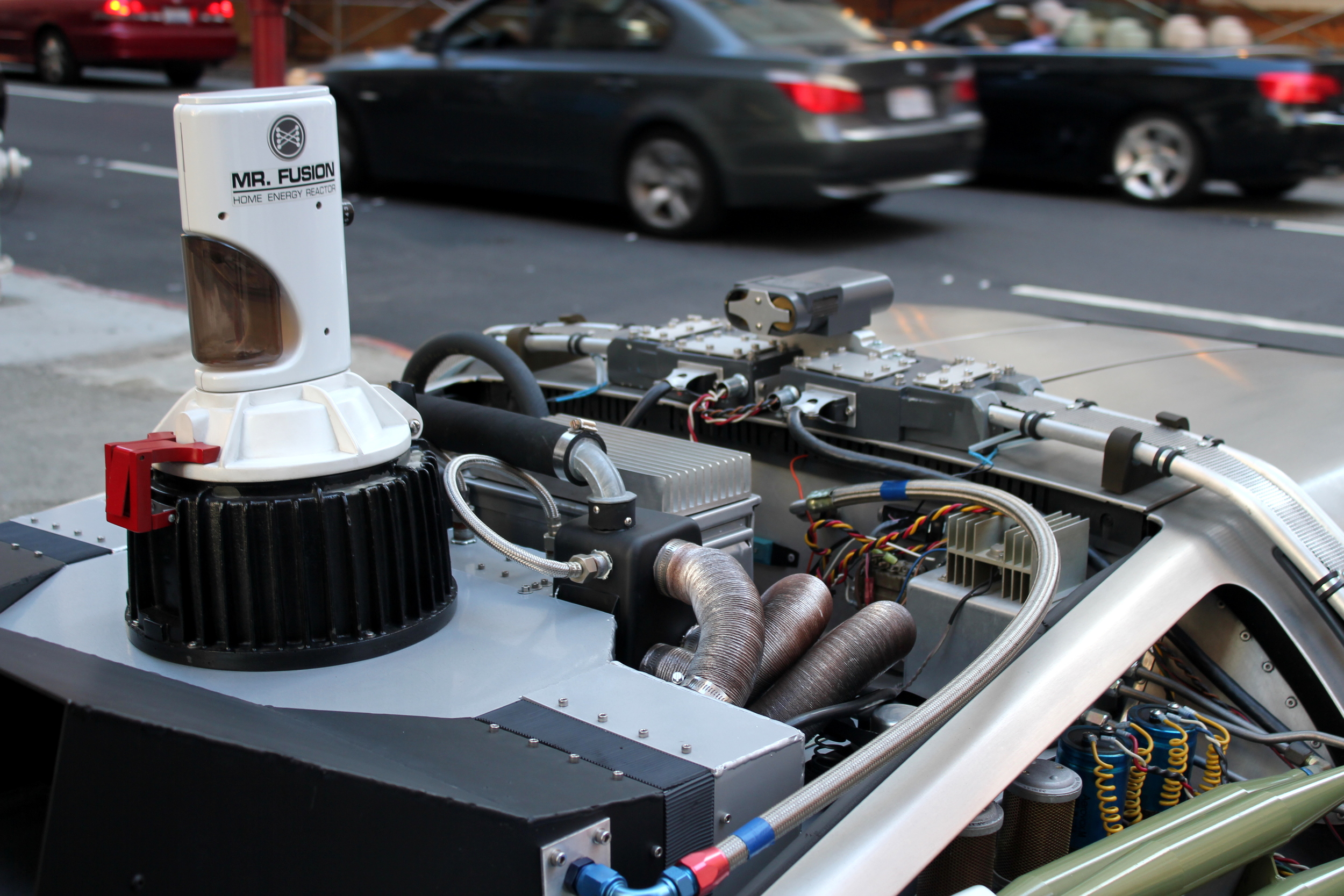
DeLorean_DMC-12_Time_Machine_-_Mr._Fusion.JPG

E=MC^2 so… we assume 371.38g of beer (I took the weight of 12 fluid ounces of water and did some guestimation since beer isn't pure water)

3.3378e+16 joules

2.4618e+16 foot-pounds

7.9775e+3 kilotons of TNT

7.9775 megatons of TNT

3.16362398 x 10^13 BTU

So

9.27166665 × 10^9 kwh or 7.97753345 × 10^12 kilocalories


Which is 9,271,666,650 kwh where the U.S. used an estimated 3.741 trillion kWh in 2009. So .002% of the U.S. energy consumption for 2009. Now... that's 1.243350979e+10 horsepower hours.

It’s also 9,271.66665 jigawatts Marty

UPDATE July 29th, 2016

So I was thinking about what such a device as the Mr. Fusion would mean as far as power for space travel... 

SpaceX's Falcon 9 rocket carries 395,700kg of fuel (119,100 Kilograms of Rocket Propellant 1 and 276,600kg of Liquid Oxygen). Let us assume that a Mr. Fusion operated at 13% efficiency (roughly what commercial solar panels operate at currently), this would give us the equivalent energy of 1.1050e+6 megatons of TNT which is 1,284,255.55 jigawatts Marty!

So mass equivalent to the weight of fuel in a a Falcon 9 would provide 1,284,255.55 terawatt hours of energy for our spacecraft at 13% efficiency. The ENTIRE PLANET used an estimated continuous average of 12.3 terawatts in 2013 (as in 12.3 terawatts being drawn every second of every day during the year) meaning a bit shy of 12 years worth of electricity for the planet, remember that's with 13% efficiency on that Mr. Fusion.

Source: https://en.wikipedia.org/wiki/Space_travel_using_constant_acceleration#/media/File:Roundtriptimes.png

Source: https://en.wikipedia.org/wiki/Space_travel_using_constant_acceleration#/media/File:Roundtriptimes.png

In the above chart, not my math, a 1g constant acceleration would get a ship to Proxima Centauri in less than 10 years ROUNDTRIP (for whoever, or whatever was on the ship, relativity and all). Now that you have essentially unlimited electrical power you'd just need to develop some sort of electric propulsion system and sail the stars, maybe some sort of magnetic field propulsion.

This week in space

Russia eyes caves on moon for setting up a lunar base

Wait... you know what this reminds me of? This reminds me of 1901's First Man in the Moon story and 1964's First Man In The Moon film.

For the time being, it appears NASA has set aside any ambitions to return to the Moon with human missions. But Russia may consider sending cosmonauts to the lunar surface to set up a colony using natural caves and possible volcanic tunnels as protection from the harsh lunar environment.

Read more HERE


Record-breaking photo reveals a planet-sized object as cool as the Earth


Now the important question, do we start listening to it or do we start broadcasting?

The photo of a nearby star and its orbiting companion -- whose temperature is like a hot summer day in Arizona -- will be presented by Penn State Associate Professor of Astronomy and Astrophysics Kevin Luhman during the Signposts of Planets conference at NASA's Goddard Space Flight Center on 20 October 2011. A paper describing the discovery will be published in the Astrophysical Journal.

Read more HERE


Youngest planet seen as it's forming

That's neat, that's all I really have to say about it.

The first direct image of a planet in the process of forming around its star has been captured by astronomers who combined the power of the 10-meter Keck telescopes with a bit of optical sleight of hand.

Read more HERE


Spitzer detects comet storm in nearby solar system

This is cool as it could add considerable amounts of water to planets in the system, similar to the article just below this.

NASA's Spitzer Space Telescope has detected signs of icy bodies raining down in an alien solar system. The downpour resembles our own solar system several billion years ago during a period known as the "Late Heavy Bombardment," which may have brought water and other life-forming ingredients to Earth.

Read more HERE


Nearby planet-forming disk holds water for thousands of oceans

If you look back to some of my earlier installments of this week in space you'll find that a generally accepted theory for how planets get their water is from comets and similar bodies in space, now here we have evidence of a water disk that might be how the comets are created to start the process.

For the first time, astronomers have detected around a burgeoning solar system a sprawling cloud of water vapor that's cold enough to form comets, which could eventually deliver oceans to dry planets.

Read more HERE

Chuck Lorre Productions #361

Miscellaneous Show Biz Tips

Never forget that taking a bow and ducking are essentially the same thing.

The reason you suffer is because you think your identity and worth as a human being are inextricably tied into your career. Don't think that.

Success has many parents, and even more lawyers.

They're paying you a lot because they're killing you.

Don't grow too attached to your agent. Like a beloved spouse, they come and go.

If you want fair, go to Pomona September 8-26. Wear comfy shoes.

It's not true that if you believe the good reviews, you must also believe the bad ones. The bad ones could have been written by mean, stupid people who hate your success.

Act like your job is the most important thing in the world, but never forget that it's ultimately meaningless. All we are is dust in the wind, yada-yada-yada

-Chuck Lorre

This week in space

Daring Russian sample return mission to Martian moon Phobos aims for November liftoff

This will be an awesome mission if it is succesful. Returning samples from another moon in our solar system will give us something new to study so that we might unerstand more about our neighborhood. Although, Phobos might not be a moon and in fact a space station or craft ( http://www.enterprisemission.com/Phobos.html )

In just over three weeks’ time, Russia plans to launch a bold mission to Mars whose objective, if successful , is to land on the Martian Moon Phobos and return a cargo of precious soil samples back to Earth about three years later.

Read more HERE


Hubble survey carries out a dark matter census

This might be an idirect method for detecting dark matter, then again it might be detecting something else entirely.

The NASA/ESA Hubble Space Telescope has been used to make an image of galaxy cluster MACS J1206.2-0847. The apparently distorted shapes of distant galaxies in the background is caused by an invisible substance called dark matter, whose gravity bends and distorts their light rays. MACS 1206 has been observed as part of a new survey of galaxy clusters using Hubble.

Read more HERE


G299.2-2.9, a middle-aged supernova remnant

I just thought this was beautiful and thought I'd share it.

G299.2-2.9 is an intriguing supernova remnant found about 16,000 light years away in the Milky Way galaxy. Evidence points to G299.2-2.9 being the remains of a Type Ia supernova, where a white dwarf has grown sufficiently massive to cause a thermonuclear explosion

Read more HERE


Clearing the cosmic fog of the early universe: Massive stars may be responsible

While an interesting theory with some evidence, I don't much care... again I just thought this was beautiful.

The space between the galaxies wasn't always transparent. In the earliest times, it was an opaque, dense fog. How it cleared is an important question in astronomy. New observational evidence from the University of Michigan shows how high energy light from massive stars could have been responsible.

Read more HERE


Distant galaxies reveal the clearing of the cosmic fog

This is just an interesting look into the early universe, and again a beautiful image.

Scientists have used ESO's Very Large Telescope to probe the early Universe at several different times as it was becoming transparent to ultraviolet light. This brief but dramatic phase in cosmic history occurred around 13 billion years ago. By studying some of the most distant galaxies, the team has been able to establish a timeline for reionisation for the first time. They have also demonstrated that this phase must have happened quicker than previously thought.

Read more HERE


Astronomers find elusive planets in decade-old Hubble data

This is great, we now have a few different ways we are detecing planets... what's great is with this data from 1998 gives us locations of objects then, and if we regularly check those areas of space regularly we will begin to detect more and more planets as we detect ones with longer and longer orbits around their star(s).

In a painstaking re-analysis of Hubble Space Telescope images from 1998, astronomers have found visual evidence for two extrasolar planets that went undetected back then.

Read more HERE


NASA to test new solar sail technology

There are many applications I can think of for this. It would be a great way to deploy communications relays for missions to the outer reaches of your solar system, after deploying such a network you could then send probes all over our solar system and have them be able to radio back reliably via the network. Could use them on satellites for cheap repositioning in orbit. Then of course you could develop very large ones and push them with masers to get a ship up to a significant fraction of the speed of light.

Solar sails, much like anti-matter and ion engines appear at first glance to only exist in science fiction. Many technologies from science fiction however, become science fact.

Read more HERE


The hazy history of Titan's air

Titan is an excellent candidate for life. Microbrial for almost certain, and possibly even larger forms of life.

What rocky moon has a nitrogen-rich atmosphere, Earth-like weather patterns and geology, liquid hydrocarbon seas and a relatively good chance to support life? The answer is Titan, the fascinating moon of Saturn.

Read more HERE


NASA books 1st flight from New Mexico spaceport

This is just great because it gives the fledling private space industry a customer, something very important in getting it going strong.

NASA has booked a charter suborbital flight from Virgin Galactic's spaceport operations in southern New Mexico.

Read more HERE